
 Back to Blogs

Custom Website vs Template Website: Evaluating Architectural ROI for Growing Businesses
Choosing between a custom website and a template website is not primarily a visual decision. For a growing organization, it is an architectural decision that influences performance, technical ownership, operational flexibility, search visibility, security, integration capacity, and long-term cost.
A template website starts with an existing structural framework. Themes, page builders, predefined components, plugin ecosystems, and standardized content models reduce the work required to launch. This can be appropriate for organizations whose digital requirements are predictable and unlikely to expand significantly.
A custom website begins with business requirements rather than an existing interface framework. Architecture, data models, integrations, navigation, design systems, conversion pathways, and deployment infrastructure can be engineered around specific operational goals.
The correct decision therefore depends on cost-to-value architecture. The central question is not whether custom development is inherently superior, but whether the website must function as a strategic business system or primarily as a publishing and presentation layer.
Understanding Template Websites: Speed to Market vs Architectural Constraints
Template websites reduce initial development effort because major interface components already exist. A company can select a WordPress theme, Shopify theme, SaaS website builder, or another pre-built framework and configure branding, content, navigation, and selected functionality.
This significantly lowers the barrier to initial Web Development. For a small informational website, campaign microsite, early-stage business, or organization validating market demand, that efficiency may justify the architectural limitations.
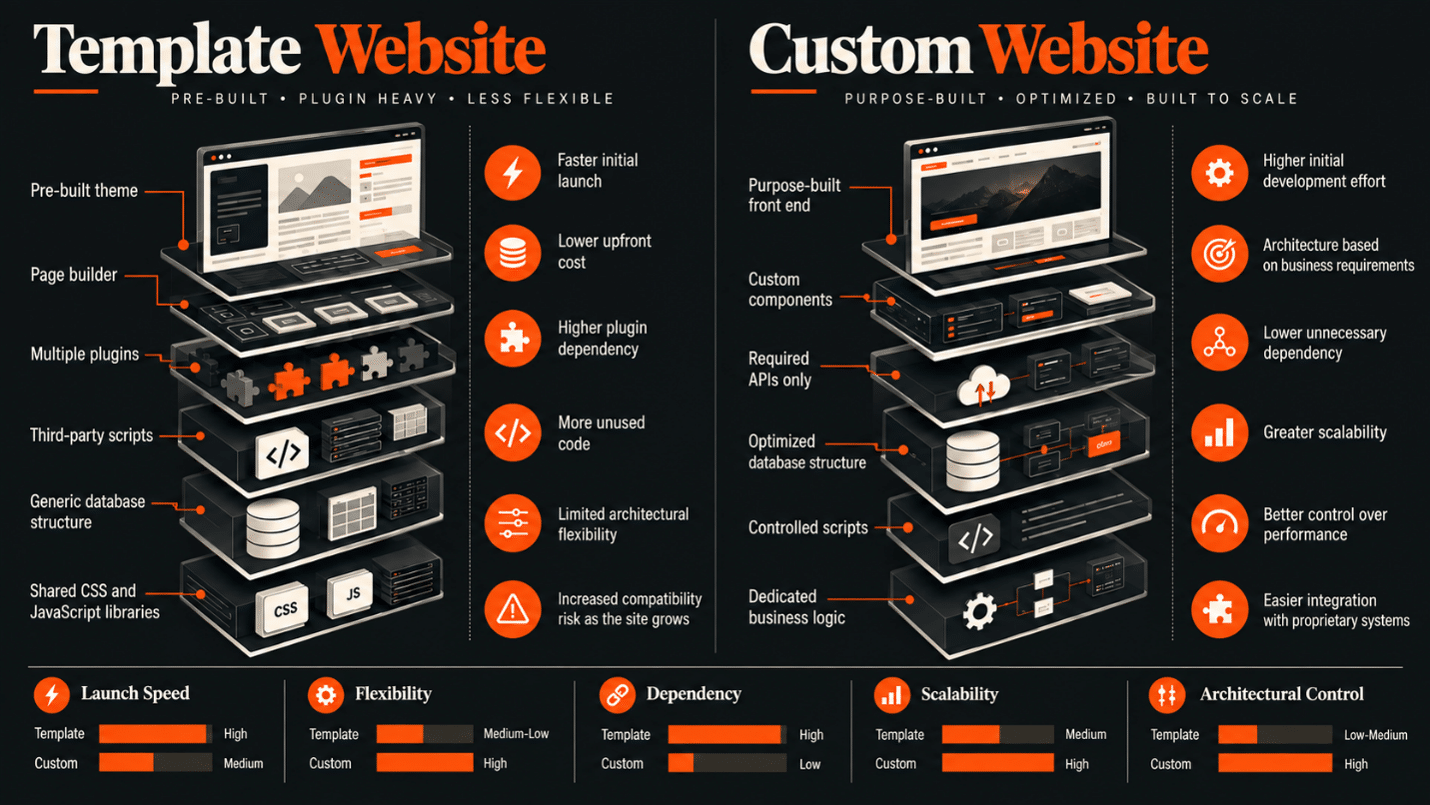
Problems emerge when requirements move beyond what the original template anticipated. Page builders frequently introduce nested containers, large CSS libraries, JavaScript dependencies, unused components, plugin-specific markup, and functionality that loads even when individual pages do not require it.
HTTP Archive’s 2025 CMS analysis illustrates the scale of modern payloads. Median mobile pages generated by WordPress were approximately 2.9 MB, while some CMS platforms approached 4 MB. The report also notes that themes, plugins, page builders, analytics, advertising systems, and other third-party services influence JavaScript payloads significantly. Implementation quality remains critical because two websites running the same CMS can perform very differently. (Source: HTTP Archive)
A professional web developer can optimize a template substantially through caching, asset removal, image optimization, script deferral, critical CSS, CDN configuration, and selective plugin use. The limitation is that optimization still occurs inside an architecture whose underlying assumptions were established before the business requirements were known.
The Power of Custom Web Development Services: Scalability, Security, and Ownership
Custom Web Development Services approach a website as an engineered application rather than a collection of pre-existing components. Developers can define the minimum architecture required for each workflow and expand it as business requirements evolve.
A tailored system can use semantic HTML, reusable components, controlled CSS, purpose-specific JavaScript, structured APIs, database models, authentication layers, caching strategies, queues, webhooks, and infrastructure selected for measurable requirements.
This becomes particularly valuable when the website must connect to CRM platforms, ERP systems, inventory databases, payment infrastructure, customer portals, analytics pipelines, internal applications, identity providers, or proprietary business systems.
Custom architecture also reduces unnecessary dependencies. Instead of installing a large plugin to obtain one function, a web developer can implement only the required capability or integrate directly with an appropriate API. This can reduce update conflicts, abandoned dependencies, redundant requests, and unexpected functionality changes.
Security benefits come from control rather than from custom code alone. Poorly engineered proprietary software can still be vulnerable. The advantage is that organizations can define authentication rules, authorization boundaries, logging, data handling, rate limiting, input validation, dependency policies, secrets management, and deployment procedures according to their own risk requirements.
A capable web development company can also document ownership boundaries clearly. Source code, infrastructure configuration, API contracts, data models, deployment processes, and design systems can remain organizational assets instead of being tightly coupled to a specific commercial theme.
Semantic SEO and AI-Readability: Custom Architecture vs Pre-Built Themes
Search visibility increasingly depends on how clearly a digital system communicates entities, relationships, hierarchy, and page purpose to machines.
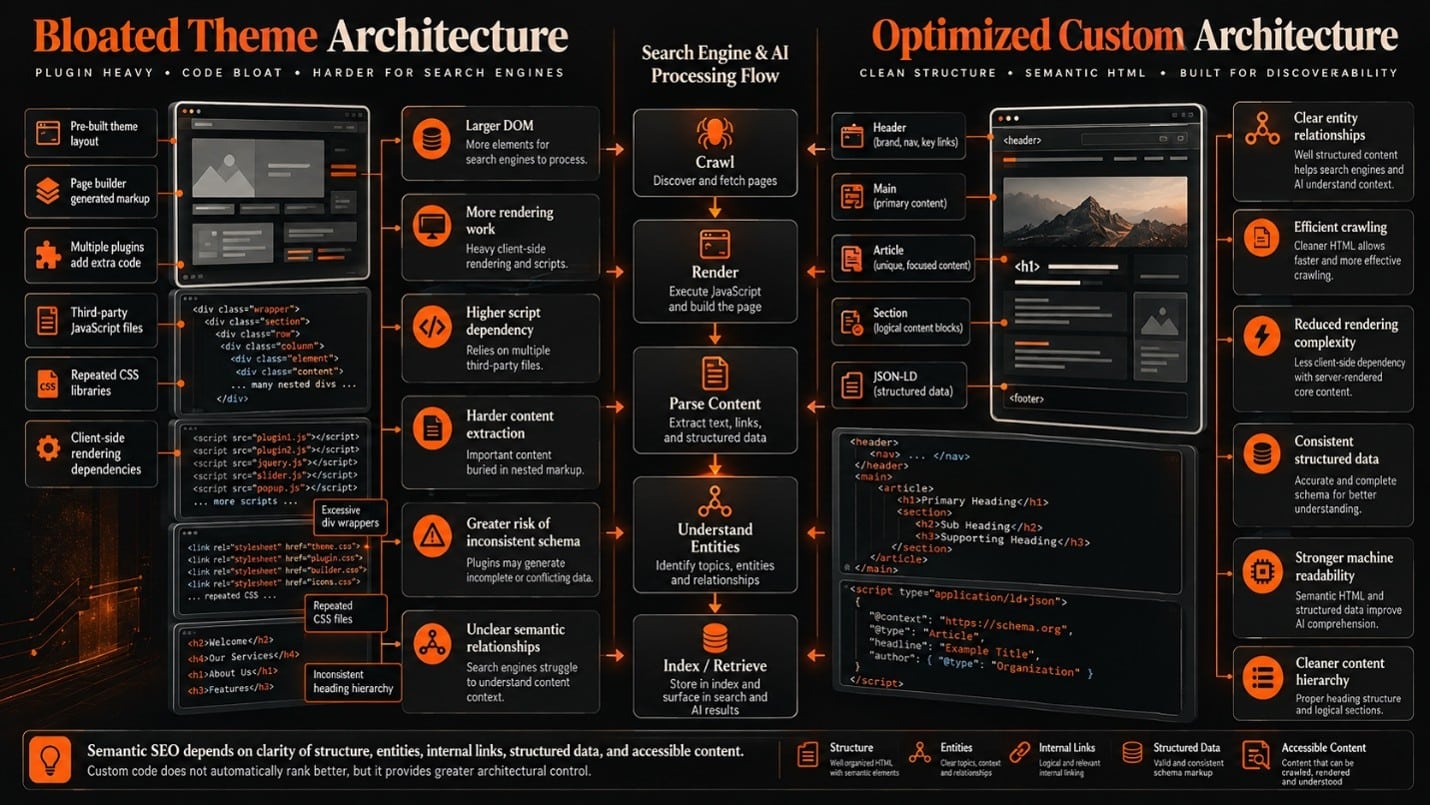
Neither Google nor an AI retrieval system provides a ranking advantage simply because a website uses custom code. What matters is whether important information can be discovered, rendered, interpreted, and associated with the correct entities.
Google explains that JavaScript websites pass through crawling, rendering, and indexing. It also states that server-side rendering or pre-rendering remains useful because it can improve accessibility for users and crawlers, while not every bot executes JavaScript. (Source: Google Search Central)
Custom Web Development Services provide greater control over this process. Teams can expose meaningful content in initial HTML, control heading hierarchy, minimize unnecessary DOM depth, establish canonical relationships, manage internal links, define entity references, and implement JSON-LD schemas directly within the application architecture.
A template can support the same principles, but page builders may introduce unnecessary wrappers, duplicated markup, inconsistent heading structures, or client-side dependencies that require additional remediation.
The objective is information gain and machine clarity. Product, organization, service, article, author, location, event, and FAQ entities should be represented consistently across visible content, metadata, internal linking, structured data, and relevant external references.
Clean Web Development therefore supports Semantic SEO when architecture and content modeling are designed together.
Aligning Web Design with Brand Architecture and Conversion Rates
Template-driven web design begins with a predefined interaction vocabulary. The organization generally selects from existing hero structures, card systems, navigation layouts, forms, product grids, landing page sections, and checkout patterns.
That can create acceptable experiences quickly, but it may also force a specialized sales process into a generic user journey.
Bespoke web design reverses the sequence. Teams can begin with audience research, buyer intent, sales stages, information requirements, objections, device behavior, content hierarchy, accessibility, analytics data, and business goals. Interface patterns are then selected according to those requirements.
The commercial impact can be substantial when high-value journeys are involved. Baymard Institute reports that the average large e-commerce site could potentially increase conversion by approximately 35% through checkout design improvements alone. Its research also finds widespread usability problems across major commercial sites, reinforcing the connection between interaction architecture and transaction performance. (Source: Baymard Institute)
Performance compounds the UX question. Portent’s study of B2B lead-generation sites found that a site loading in one second recorded a conversion rate approximately three times that of a site loading in five seconds. Correlation does not mean speed alone caused every conversion difference, but the data reinforces the commercial importance of performance engineering. (Source: Portent)
A custom design system gives teams direct control over both the customer journey and the technical resources required to deliver it.
Financial Analysis: Initial Capital Outlay vs Long-Term Total Cost of Ownership (TCO)
Template websites usually have the lower initial capital requirement. Licensing a theme, configuring a builder, purchasing several plugins, and customizing existing layouts can cost considerably less than commissioning a custom application.
Initial price, however, represents only one component of financial architecture.
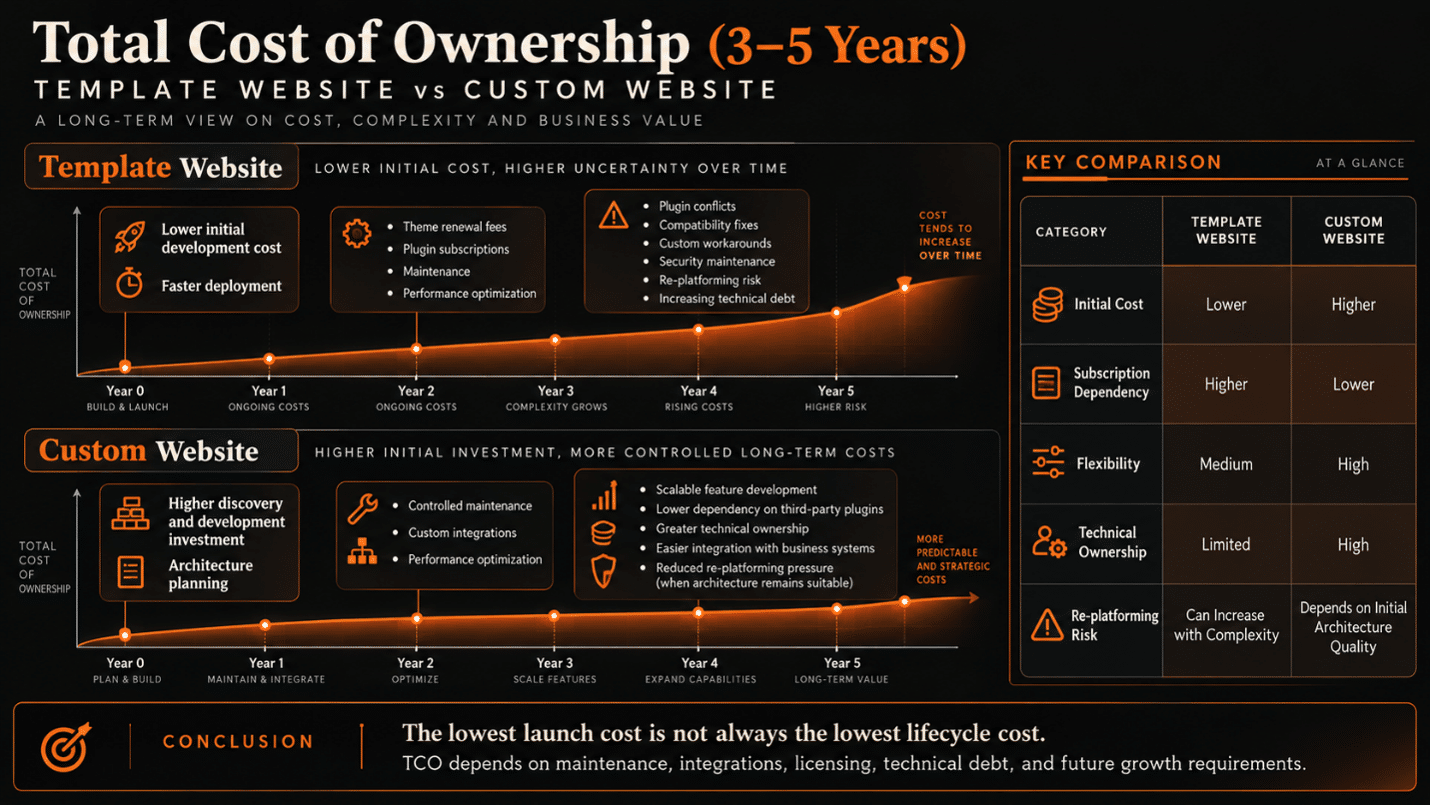
Over a three-to-five-year period, template environments may accumulate premium plugin fees, builder subscriptions, specialized hosting requirements, maintenance retainers, compatibility work, performance optimization, security remediation, redesign costs, and integration workarounds.
Technical debt also carries an opportunity cost. If a sales team needs a CRM workflow that the current site cannot support, or an e-commerce operation requires inventory synchronization outside the template’s original model, development teams may spend substantial effort extending an unsuitable foundation.
Custom Web Development Services usually require greater investment during discovery, architecture, UI planning, engineering, quality assurance, migration, and deployment. In exchange, the organization can prioritize capabilities according to expected commercial value and eliminate unnecessary platform features.
This does not mean custom development always produces a lower TCO. A lightly used corporate website may never recover the additional engineering investment.
TCO analysis should therefore include development, infrastructure, licensing, maintenance, integrations, security, internal labor, expected redesign cycles, re-platforming probability, and the financial impact of architectural constraints.
The better investment is the architecture whose lifecycle cost corresponds with the economic importance of the website.
Decision Matrix: When to Choose Templates vs Custom Web Development
Decision-makers should evaluate the website against expected operational complexity rather than selecting a platform based purely on launch cost.
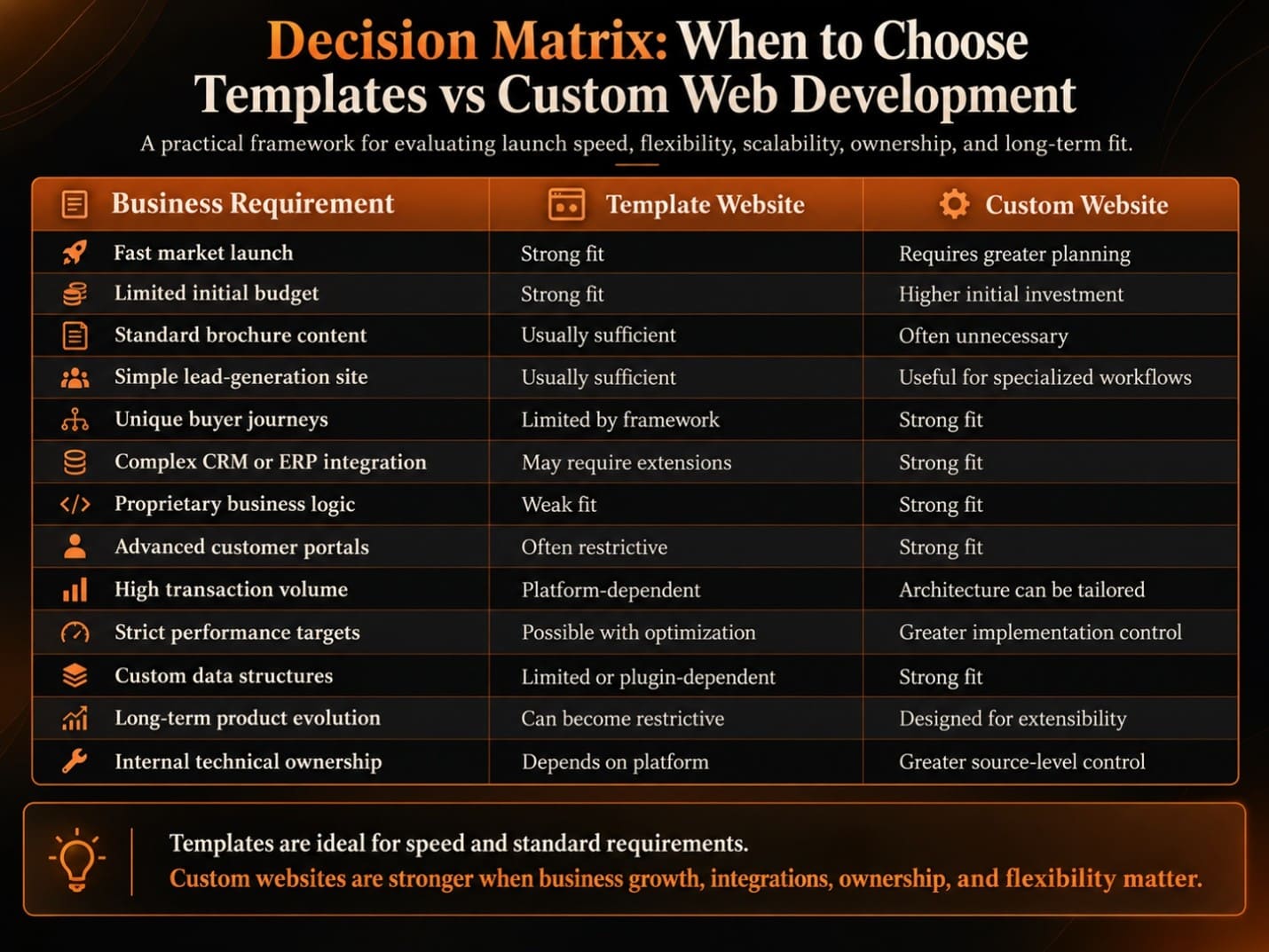
Templates are rational when the site performs a relatively standardized function, requirements are stable, launch speed matters, and architectural differentiation creates limited economic value.
Custom development becomes increasingly justified when the website influences revenue operations, customer experience, automation, proprietary workflows, large content ecosystems, regulated data, integration architecture, or digital product strategy.
There is also a hybrid option. A web development company may use a mature CMS for editorial management while developing custom themes, components, APIs, schemas, search functionality, commerce logic, or front-end applications around it.
The decision should therefore be architectural rather than ideological.
Audit Your Web Infrastructure Before Your Next Build
Before approving a new website, executives should establish what the platform must support during the next three to five years, not simply what pages must exist at launch.
Audit current performance, conversion friction, content architecture, technical SEO, structured data, accessibility, integrations, security dependencies, analytics quality, maintenance costs, and anticipated operational requirements. Then identify which limitations originate from implementation quality and which are structural constraints of the existing platform.
Organizations considering Custom Web Development Services should require architecture decisions to be connected to measurable business requirements. Likewise, organizations selecting a template should define performance budgets, plugin governance, update procedures, schema standards, design-system rules, and clear thresholds for future re-platforming.
The strongest Web Development strategy is the one that gives the organization sufficient technical capability without purchasing complexity it cannot economically justify.
Before committing capital to either model, conduct a technical audit and develop an architecture roadmap. The goal is not simply to select a website platform. It is to determine whether the digital infrastructure can support the business model, customer experience, search strategy, integration requirements, and growth plans it will be expected to serve.


