Back to Blogs
The Modern Paradox: High Google Rankings Do Not Guarantee AI Search Visibility
A website can hold first-page positions in Google and still remain absent when buyers ask ChatGPT, Perplexity, Gemini, or Google AI Overviews for recommendations, comparisons, or explanations. The reason is structural traditional ranking systems primarily order documents, while generative systems retrieve, synthesize, and cite passages, entities, and sources that best support an answer.
For enterprise marketing teams, this creates a measurement problem. Search Engine Optimization can still produce strong rankings, impressions, and organic authority, yet those indicators do not reveal whether a brand is being retrieved inside AI-generated responses. Visibility now has two layers: discoverability in ranked results and inclusion in synthesized answers.
Google states that established SEO best practices remain relevant because its generative features rely on core Search ranking and quality systems, including retrieval-augmented generation. That makes conventional SEO foundational, but not sufficient as the only visibility model. (Source: Google Search Central)
The Split Ecosystem: Traditional SERPs Versus Generative Answer Engines
Traditional SERPs reward a page for relevance, authority, technical accessibility, and intent alignment, then position it among competing links. Generative answer engines perform a different task. They interpret a question, retrieve supporting material, evaluate candidate sources, and assemble an answer that may cite only a small subset of the pages available.
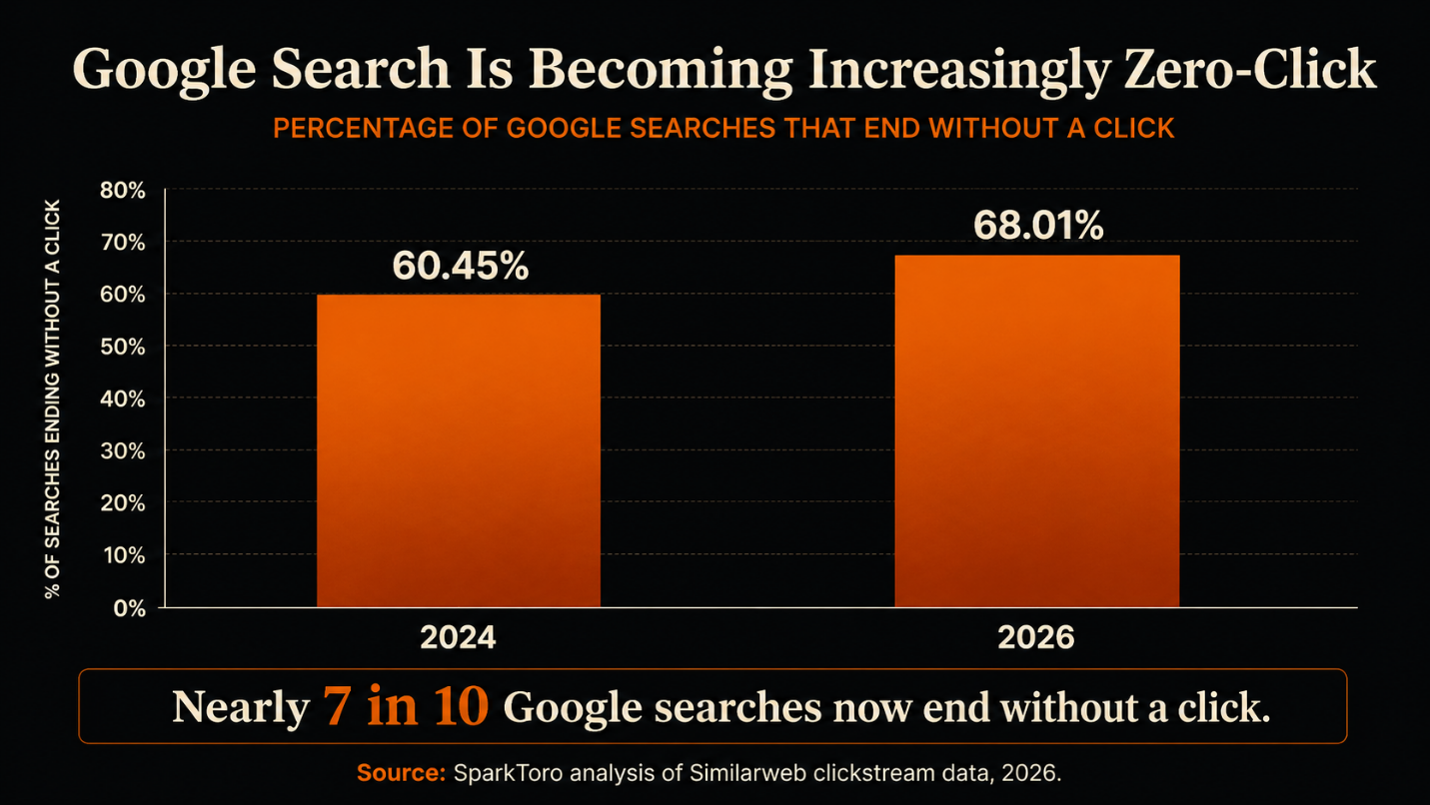
The commercial consequence is already visible in click behavior. SparkToro’s June 2026 analysis of Similarweb’s U.S. desktop and mobile panel found that 68.01% of Google searches in the first four months of 2026 ended without a click. The 2024 figure was 60.45%, indicating a sharp increase in search journeys resolved without a visit. (Source: SparkToro, using Similarweb clickstream data)
Ranking therefore cannot be treated as a complete proxy for visibility. A page may rank third for a strategic query while an AI system cites another domain with cleaner answer passages, stronger entity associations, fresher evidence, or better corroboration across the web. Enterprise reporting needs to separate ranking performance from generative inclusion.
Why Legacy Search Engine Optimization Fails in AI Overviews
Legacy Search Engine Optimization often concentrates on keyword targeting, title tags, meta descriptions, link acquisition, and page-level ranking improvements. Those practices remain useful, but they can underperform when content is optimized as a document rather than as a source that can be retrieved in meaningful fragments.
Large language model interfaces process relationships between entities, claims, attributes, questions, and supporting evidence. Repeating a keyword across a page does little to clarify whether the organization has credible expertise on a specific subtopic, whether a statistic is attributable, or whether a paragraph can answer a narrow follow-up question without surrounding context.
Google’s current guidance reinforces this distinction. Pages still need to be crawlable, indexed, technically eligible, and useful to people, while AI features can use retrieval and query expansion to locate supporting pages for complex questions. The strategic implication is not to abandon classic optimization, but to extend it toward machine-readable context, extractable answers, and stronger source credibility. (Source: Google Search Central)
Leveraging Semantic SEO for Contextual Authority and Entity Mapping
Semantic SEO organizes content around meaning rather than isolated search terms. It connects a brand to the entities, attributes, products, services, problems, use cases, and expert concepts that define its domain. This gives search systems a clearer basis for understanding what the organization is authoritative about.
For example, an enterprise cybersecurity provider should not publish disconnected articles targeting high-volume phrases alone. Its information architecture should connect identity security, privileged access, zero trust, authentication, compliance frameworks, threat models, deployment scenarios, and buyer questions through consistent internal linking and terminology.
Effective SEO Techniques in this environment include entity-first content planning, topic clusters based on real decision journeys, descriptive internal anchors, structured data that matches visible content, expert attribution, original research, and clear relationships between corporate, service, author, and product entities. These signals help algorithms map the brand within a knowledge context instead of treating each URL as an isolated asset.
Topical authority is therefore cumulative. The objective is to create enough consistent evidence that retrieval systems repeatedly associate the brand with a defined set of subjects and claims.
Advanced SEO Techniques for Retrieval-Augmented Generation (RAG)
Retrieval-augmented generation changes the unit of competition. A generative system may not need an entire article. It may retrieve one passage that directly answers a sub-question, combine it with evidence from other sources, and use that material to ground the final response.
Advanced SEO Techniques should therefore improve passage-level usefulness. Important pages need clear H2 and H3 structures, concise definitions, answer-first paragraphs, explicit comparisons, self-contained explanations, current statistics, and tables or lists only when they clarify relationships. Each section should make sense when retrieved independently.
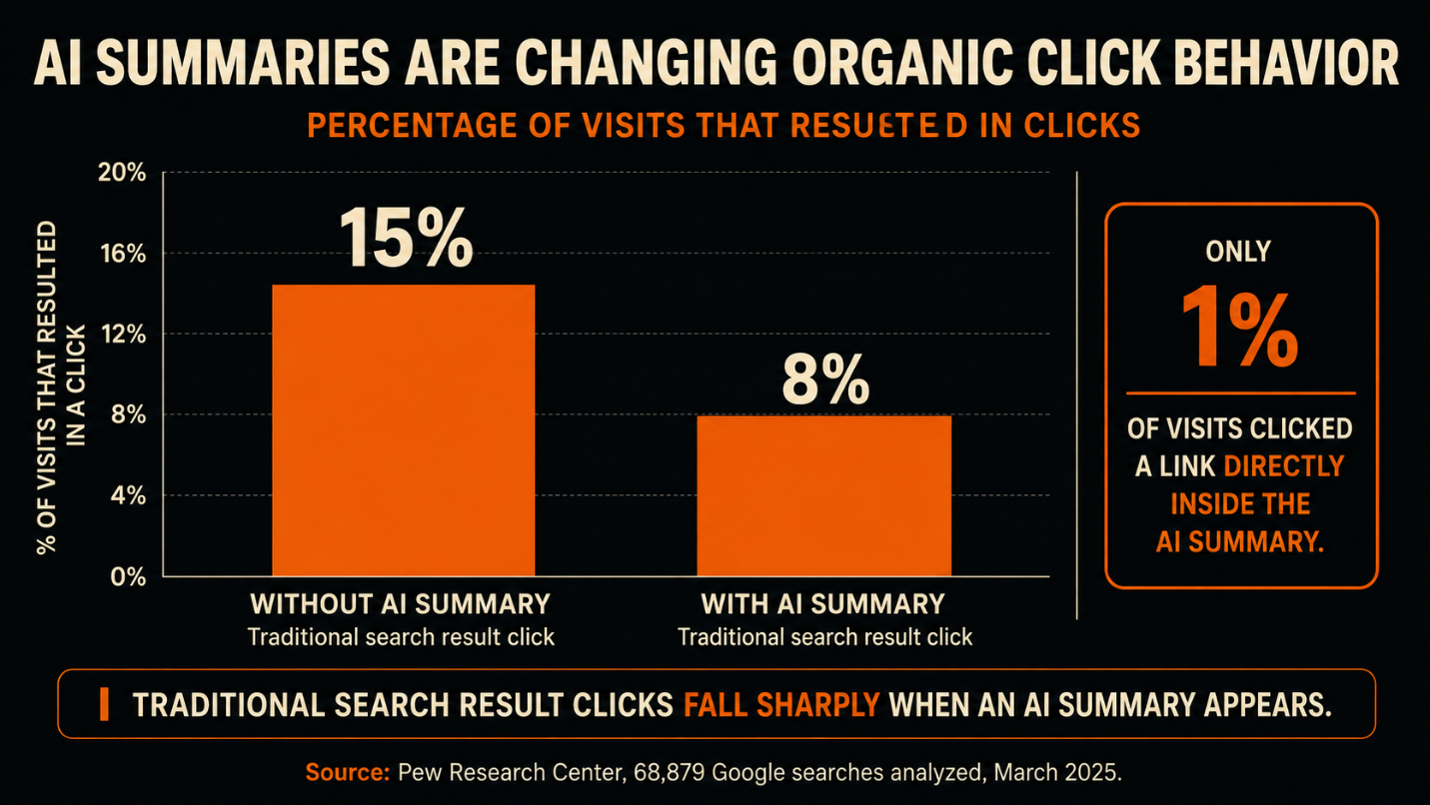
The urgency is measurable. Pew Research Center analyzed 68,879 Google searches from March 2025 and found that users clicked a traditional result on 8% of visits when an AI summary appeared, versus 15% when no AI summary appeared. Links inside the AI summaries themselves received clicks in only 1% of visits. (Source: Pew Research Center)
This does not mean every page should be rewritten as a snippet library. It means content architecture should support both human depth and machine retrieval. Search Engine Optimization teams should test whether high-value passages answer the exact questions executives, buyers, analysts, and AI systems are likely to ask.
Evaluating Professional SEO Services and Content Auditing
Professional SEO Services should now evaluate visibility across search engines and generative platforms as separate but connected systems. A standard audit that ends with crawl errors, rankings, backlinks, and metadata leaves a major discovery layer unmeasured.
A modern engagement should examine whether priority entities are understood consistently, whether strategic pages are cited by AI systems, which competitors dominate prompt-level answers, what source types are repeatedly selected, and whether brand mentions occur with accurate positioning. SEO Services should also identify citation gaps, source volatility, unsupported claims, weak entity relationships, and content sections that are difficult to retrieve cleanly.
SE Ranking’s AI Mode research illustrates why this matters. In a study of 10,000 keywords, only 14% of AI Mode citation URLs overlapped with Google’s organic top 10, while domain-level overlap was 21.9%. Across three repeated tests of the same queries, only 9.2% of cited URLs remained the same. (Source: SE Ranking)
That volatility changes auditing. Success is not a single citation screenshot. It is repeatable inclusion across query families, engines, dates, and buyer intents.
Utilizing Modern SEO Tools to Track AI Citations and Brand Mentions
Traditional SEO Tools were built around positions, traffic estimates, backlinks, technical errors, and SERP features. Those metrics remain essential, but executive teams now need observability inside generative environments as well.
Modern SEO Tools should track prompt-level share of voice, cited URLs, cited domains, brand mentions without links, competitor inclusion, sentiment or positioning, answer consistency, query category coverage, and changes in source selection over time. They should also distinguish visibility in Google AI Overviews, AI Mode, ChatGPT search, Perplexity, Gemini, and other relevant interfaces because citation behavior varies by engine.
SE Ranking’s cross-engine study of 2,000 queries found limited sourcing alignment across AI systems. Perplexity and ChatGPT shared 25.19% of cited domains, while Google AI Overviews and ChatGPT shared 21.26%. This indicates that visibility in one engine cannot reliably stand in for visibility across the entire generative ecosystem. (Source: SE Ranking)
For CMOs, the reporting model should therefore connect classic Search Engine Optimization KPIs with AI citation rate, brand inclusion rate, prompt coverage, and qualified downstream demand. The strategic question is no longer only, “Where do we rank?” It is also, “When an AI system answers the buyer’s question, are we part of the evidence?”
Audit Your Brand Presence for the Generative Era
Enterprise search visibility now depends on being technically eligible, semantically clear, credible enough to retrieve, and useful enough to cite. Rankings still matter, but they represent only one surface in a fragmented discovery environment.
Business leaders should audit priority topics across Google, AI Overviews, AI Mode, ChatGPT, Perplexity, and other engines used by their buyers. The assessment should compare organic rankings with citation frequency, brand mentions, competitor share of voice, entity consistency, and source stability.
SEO Services should support that analysis with infrastructure, content, measurement, and governance rather than treating AI visibility as a separate content tactic. The organizations that establish this measurement layer early will have a clearer view of demand discovery as click-based reporting becomes less representative.
Before organic traffic weakens further, evaluate whether your brand is merely ranking or whether it is actually present in the answers influencing executive decisions.
Is Your Brand Visible Across Search and AI?
Google rankings alone no longer provide a complete view of search visibility. Your business also needs to understand how it appears across AI Overviews, ChatGPT, Perplexity, and other generative search platforms.
Talk to our team about assessing your current search visibility, identifying citation gaps, and building a stronger strategy for Google and AI-driven discovery.