
 Back to Blogs

Website Security Essentials: Protecting Business Assets in an Evolving Threat Landscape
Website security is now a business continuity requirement, not simply an IT maintenance task. A commercial website can process customer information, authenticate employees, connect to payment systems, expose APIs, collect leads, and integrate with third-party platforms. A compromise in any of these layers can affect revenue, operations, customer confidence, regulatory obligations, and search visibility.
For executives, the central issue is not whether a website can be attacked. Internet-facing systems are continuously exposed to automated scanning, credential abuse, vulnerability exploitation, malicious traffic, and supply chain weaknesses. The strategic question is whether the architecture can prevent common attacks, detect abnormal behavior, contain compromise, and recover without prolonged disruption.
Modern Web Development therefore needs security controls embedded across architecture, application code, infrastructure, authentication, deployment, monitoring, and recovery. Security also needs to remain connected to web design because authentication, checkout, consent, and account-management experiences influence how users interact with protective controls.
A secure website should be treated as an operational business asset with measurable risk, defined ownership, and an ongoing maintenance lifecycle.
The Cost of Vulnerability: Modern Threat Vectors Impacting Commercial Websites
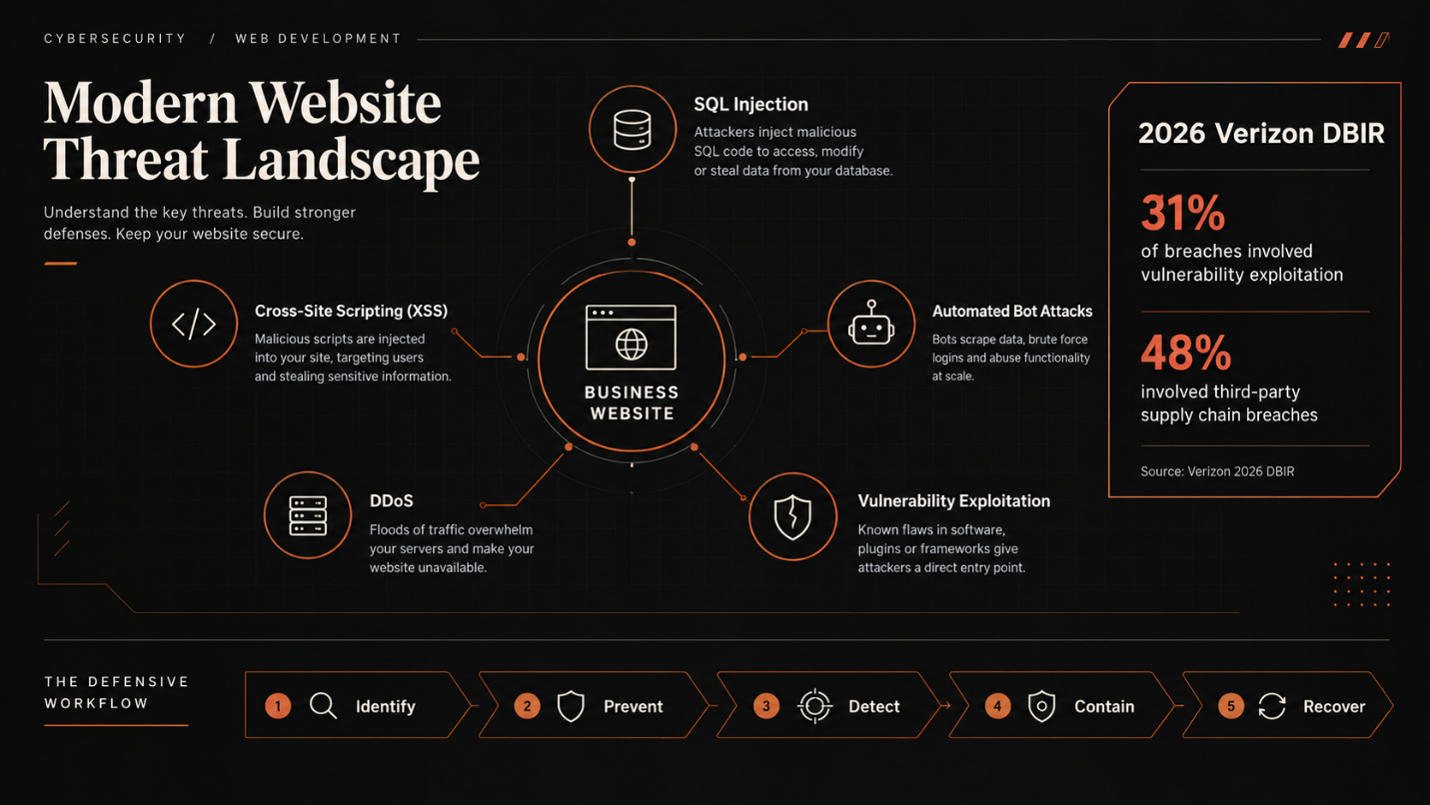
Commercial websites face multiple threat vectors, and each targets a different layer of the application stack. SQL injection attacks attempt to manipulate database queries through untrusted input. Cross-site scripting (XSS) attacks attempt to execute unauthorized scripts in a user’s browser. Automated bots can perform credential stuffing, content scraping, inventory abuse, account enumeration, and form abuse at machine speed.
Distributed denial-of-service (DDoS) attacks operate differently. Rather than exploiting application logic, they attempt to exhaust network, infrastructure, or application resources so legitimate users cannot access the service. Effective defense therefore requires multiple controls rather than a single security product.
The threat environment is becoming increasingly focused on exploiting exposed vulnerabilities. Verizon’s 2026 Data Breach Investigations Report found that vulnerability exploitation accounted for 31% of breaches, making it the leading initial access vector in that year’s analysis. The report also found that third-party supply chain breaches reached 48% of total breaches, illustrating how risk can extend beyond the organization’s own codebase. (Source: Verizon, 2026 Data Breach Investigations Report)
The financial consequences can also extend well beyond the immediate technical incident. IBM’s 2025 Cost of a Data Breach Report placed the global average cost of a data breach at approximately $4.44 million, covering factors such as detection, response, lost business, and post-breach activities. (Source: IBM, Cost of a Data Breach Report 2025)
IBM Cost of a Data Breach Report 2025
For executives, this creates a useful risk classification: application vulnerabilities, infrastructure exposure, identity compromise, malicious automation, availability attacks, and third-party dependencies should be assessed separately because their controls and failure modes differ.
The Role of Modern Web Development in Building Security-First Systems
Security begins before an application reaches production. The architecture selected during Web Development determines how authentication, authorization, data access, session management, APIs, file uploads, logging, and administrative functions will behave under hostile conditions.
Secure coding practices should establish strict boundaries around untrusted data. Input validation should verify expected data types, formats, lengths, and permitted values. Output encoding should ensure user-controlled content cannot become executable browser code. Database access should use parameterized queries or safe abstraction layers rather than constructing SQL statements from raw input.
Authentication requires equivalent architectural discipline. Passwords should never be stored in plaintext, session identifiers should be protected, administrative accounts should use strong authentication, and authorization should be enforced server-side for every sensitive operation. A hidden button or restricted front-end route is not an authorization control.
Server configuration is another critical layer. Production systems should minimize exposed services, remove unnecessary software, restrict administrative interfaces, separate environments, protect secrets, disable verbose error output, and apply secure cookie attributes. Security headers should be configured at the server or application gateway rather than treated as an afterthought within front-end code.
The 2025 OWASP Top 10 places Broken Access Control and Security Misconfiguration at the top of its current application security categories, reinforcing the importance of architectural authorization and configuration management alongside traditional vulnerability testing. (Source: OWASP, Top 10:2025)
Effective professional web development also incorporates threat modeling before implementation. Teams should identify assets, trust boundaries, entry points, privileged operations, abuse cases, and potential failure conditions before developers write production code.
How Professional Web Development Mitigates Third-Party and Supply Chain Risks
Modern websites rarely consist entirely of internally written code. Frameworks, packages, plugins, payment integrations, analytics libraries, content delivery networks, APIs, container images, deployment tools, and development dependencies all become part of the effective attack surface.
An outdated plugin can introduce a vulnerability even when the organization’s custom code is secure. A compromised package can create a malicious execution path. An abandoned library can remain embedded in a production application long after its maintainers stop publishing security updates.
This is why dependency management should be treated as an operational security function. Professional web development teams should maintain an inventory of dependencies, monitor vulnerability databases, review transitive dependencies, remove unused components, and establish defined patching procedures.
The current OWASP Top 10 explicitly separates Software Supply Chain Failures into its own 2025 category. OWASP reports an average incidence rate of 5.19% for this category in its contributed testing data and recommends practices including software bills of materials, dependency monitoring, vulnerability scanning, staged updates, signed artifacts, and stronger CI/CD controls. (Source: OWASP, A03:2025 Software Supply Chain Failures)
OWASP A03:2025 Software Supply Chain Failures
Zero-trust principles strengthen this model by avoiding implicit trust between users, applications, services, and infrastructure. Access should be authenticated, authorized, and limited according to the resource and operation being requested.
For development pipelines, this means protecting source repositories, restricting deployment credentials, separating environments, securing build infrastructure, scanning artifacts, and preventing production secrets from entering source code. Security ownership should continue after launch because dependency risk changes throughout the application’s lifecycle.
Secure Web Design: Aligning User Experience with Security Protocols
Security controls fail when users cannot understand or practically use them. Web design therefore has a direct role in security adoption, particularly across authentication, checkout, account recovery, consent, payment, and privacy experiences.
Multi-factor authentication is a useful example. A security-first interface should explain why an additional factor is required, preserve recognizable authentication patterns, provide accessible recovery mechanisms, and avoid unnecessary steps that encourage users to bypass controls.
Current industry adoption data demonstrates the movement toward stronger authentication. Okta’s 2025 Secure Sign-in Trends Report found that workforce MFA adoption reached 70%, while adoption of phishing-resistant passwordless authentication increased 63% year over year, from 8.6% to 14.0% of users. (Source: Okta, Secure Sign-in Trends Report 2025)
Okta Secure Sign-in Trends Report 2025
Checkout security requires the same balance. Payment forms should clearly communicate which information is required, avoid collecting unnecessary sensitive data, use secure payment infrastructure, and provide recognizable confirmation states. Privacy controls should explain data collection and permissions without hiding important choices behind ambiguous interface patterns.
Good web design does not remove security controls to reduce friction. It organizes those controls so legitimate users can understand them and attackers have fewer opportunities to exploit confusion.
This principle extends to error messages, password reset screens, session expiry notices, file uploads, and administrative interfaces. The visual layer should reinforce the security model established by the underlying Web Development architecture.
Technical Checklist: Core Security Infrastructure for Business Websites
A business website should have a defined baseline of technical controls that can be verified periodically. The following layers represent core infrastructure rather than optional enhancements:
- TLS/SSL encryption: Enforce HTTPS across the entire website and protect sensitive communications from interception. Use valid certificates, modern TLS configurations, and secure redirects from HTTP to HTTPS.
- Content Security Policy (CSP): Define which sources browsers are permitted to load or execute. A properly configured CSP can reduce the impact of XSS and certain code-injection attacks by restricting unauthorized scripts and content sources. (Source: OWASP, Content Security Policy Cheat Sheet)
OWASP Content Security Policy Cheat Sheet
- Web Application Firewall (WAF): Filter and monitor malicious HTTP traffic before it reaches application infrastructure. WAF rules should complement secure application code rather than substitute for it.
- HTTP security headers: Configure controls such as HSTS, CSP, X-Content-Type-Options, and appropriate framing protections. OWASP notes that security headers can mitigate risks including clickjacking, content-type confusion, and certain XSS scenarios. (Source: OWASP, HTTP Headers Cheat Sheet)
OWASP HTTP Headers Cheat Sheet
- Automated backups: Maintain encrypted, access-controlled backups with defined retention periods. Backups should be isolated from ordinary production credentials and tested through actual restoration procedures.
- Centralized logging and alerting: Capture authentication events, privilege changes, administrative activity, application errors, suspicious requests, and infrastructure events. Alerts should be connected to defined incident response procedures.
- Vulnerability management: Scan applications, dependencies, infrastructure, and exposed services on a recurring basis. Prioritize remediation according to exploitability, exposure, asset importance, and business impact.
- Identity and access controls: Apply least privilege to administrators, developers, service accounts, APIs, and deployment systems. CISA’s zero-trust guidance emphasizes granular access enforcement and least-privilege decisions rather than implicit network trust. (Source: CISA, Ransomware Guide)
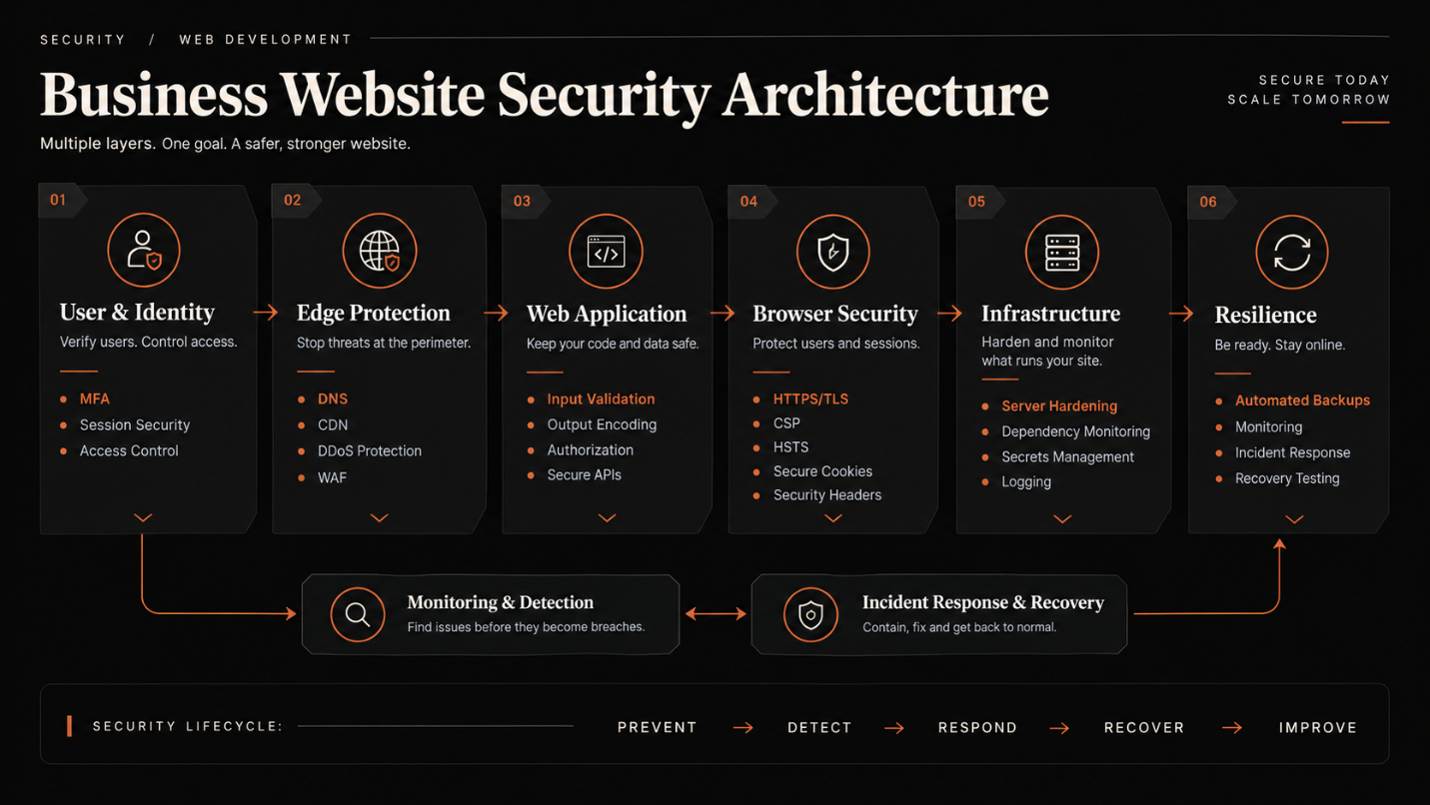
These controls should be documented as part of the organization’s website security baseline. Ownership should be assigned so that certificates, patches, backups, monitoring, dependencies, and access permissions do not become unmanaged responsibilities.
Semantic SEO and Search Engine Trust: How Security Impacts Ranking Authority
Website security intersects with SEO primarily through accessibility, user safety, crawlability, and the integrity of indexed content. A compromised website can have legitimate pages altered, malicious pages injected, spam content introduced, or users redirected toward unsafe destinations.
Google explicitly maintains security monitoring within Search Console and can display warnings or interstitials when it detects threats such as malware or phishing. Google also states that security threats can reduce Search traffic when users encounter warnings before reaching affected pages. (Source: Google Search Central)
Google Search Central: Debugging Search Traffic Drops
Hacked content creates another SEO risk because attackers can inject unauthorized pages or code into an otherwise legitimate domain. Google identifies hacked content as content placed on a website without permission because of security vulnerabilities, including injected code and unauthorized pages. (Source: Google Search Central)
Google Search Central: Spam Policies and Hacked Content
HTTPS is also part of Google’s recommended technical foundation for secure websites. Google recommends HTTPS instead of HTTP for user and site security, while its ranking documentation makes clear that Search uses many signals rather than a single universal security score. Security should therefore be viewed as an enabler of a stable search presence, not as a shortcut to higher rankings. (Source: Google Search Central)
For semantic SEO, this distinction matters. Search engines need reliable access to legitimate content, while compromised domains can introduce conflicting entities, unauthorized URLs, malicious scripts, spam signals, and indexing anomalies. Protecting the technical integrity of the domain therefore supports the consistency of its search footprint and the reliability of the content that crawlers encounter.
Audit Your Digital Infrastructure Before Vulnerabilities Emerge
Website security should be managed as an ongoing business risk program rather than a one-time technical project. Executives and IT leaders should know which systems are internet-facing, what data they process, which third parties they depend on, who has privileged access, how vulnerabilities are discovered, and how quickly compromised systems can be restored.
A practical security assessment should examine application code, authentication, APIs, hosting configuration, dependencies, administrative access, DNS, TLS, HTTP headers, backups, monitoring, deployment pipelines, and incident response procedures. It should also evaluate how security controls affect customer-facing web design and critical conversion paths.
Qualified web developers should be able to connect these technical controls with business requirements. The objective is not simply to identify vulnerabilities, but to establish a repeatable process for preventing, detecting, containing, and recovering from them.
For organizations relying on their website for revenue, customer acquisition, transactions, or operational services, security belongs within the core Web Development strategy. Conduct the assessment before an exposed dependency, compromised credential, misconfiguration, or unpatched vulnerability becomes a business interruption.


