20 Essential Digital Tools for Growing a Business
Business growth in 2026 increasingly depends on how effectively technology connects strategy, customer data, operations, marketing, product delivery, and decision-making. Individual software products can improve specific tasks, but the larger competitive advantage comes from building a digital stack in which systems exchange data, automate repeatable work, and support faster executive decisions.
A modern technology architecture should reduce operational friction while improving scalability. AI assistants can accelerate knowledge work, CRM platforms can organize customer intelligence, analytics systems can expose performance patterns, and cloud infrastructure can support changing traffic and application demands.
The challenge for executives is therefore not acquiring software. It is selecting tools that solve distinct operational problems while supporting an integrated business architecture.
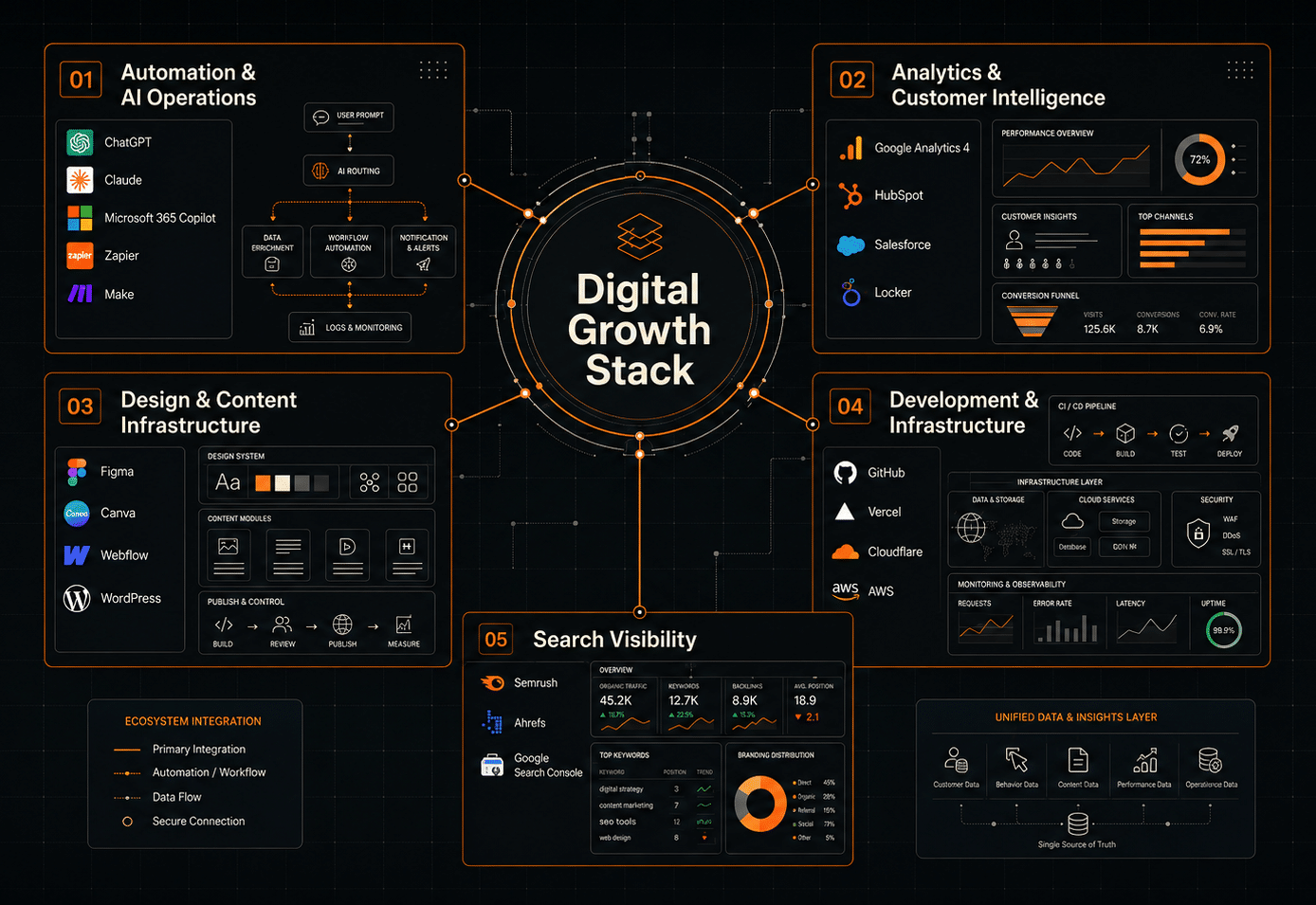
The following 20 platforms represent five strategic pillars that growing organizations should evaluate in 2026.
Navigating the 2026 Technology Ecosystem
Enterprise software is moving toward AI-native workflows in which intelligence is embedded directly inside operational systems. Employees increasingly interact with AI through productivity suites, CRM platforms, analytics environments, development tools, and automation systems rather than accessing intelligence through isolated applications.
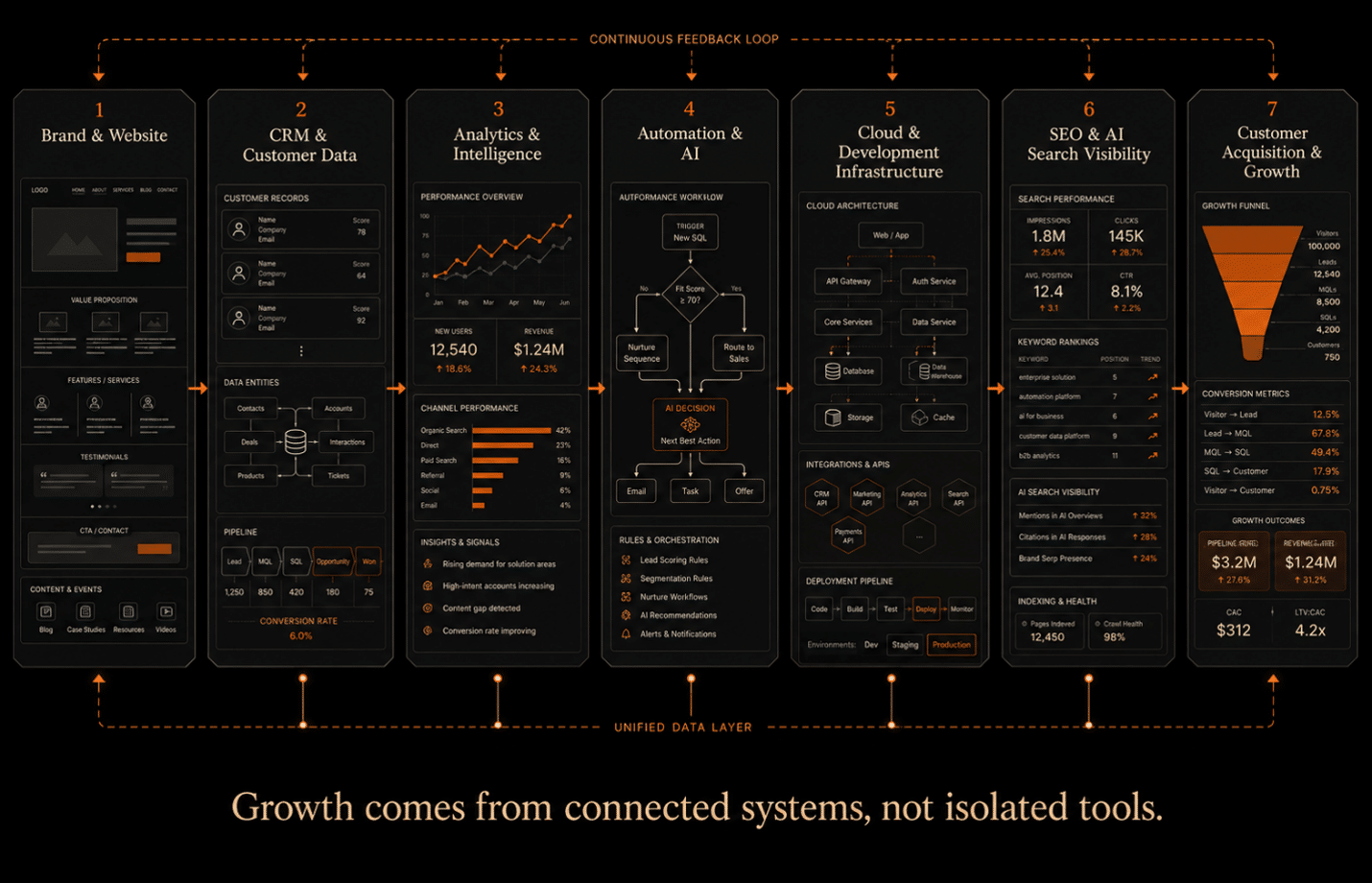
Integration has consequently become a major architecture consideration. Marketing platforms must exchange information with CRM systems, websites must communicate with analytics environments, customer data must remain consistent across channels, and automation platforms must coordinate activities between departments.
Businesses should evaluate digital tools across four dimensions: functional value, interoperability, governance, and scalability. A platform that performs one task efficiently but creates another data silo can increase long-term operational complexity.
The strongest digital stack therefore operates as an ecosystem. Data moves through connected systems while each platform maintains a clearly defined role within the business architecture.
Strategic Pillars: The 20 Growth Tools for 2026
The following tools are grouped according to operational purpose rather than popularity. This approach allows executives to evaluate capability gaps across AI operations, customer intelligence, digital experience, engineering, infrastructure, and search visibility.
Automation and AI Operations
1. ChatGPT Business and Enterprise
ChatGPT has evolved into a business productivity environment for research, analysis, writing, planning, coding, data interpretation, and workflow assistance. Organizations can use enterprise workspaces to support knowledge-intensive teams while applying centralized administration and data controls.
Its strategic value is highest when organizations establish approved workflows rather than allowing disconnected individual usage.
2. Claude for Enterprise
Claude provides another enterprise AI environment suited to document analysis, reasoning, drafting, research support, and knowledge-intensive processes. It can be particularly useful for teams working with large information sets, policies, technical material, and internal documentation.
Organizations can use multiple AI systems where different reasoning or workflow requirements justify them.
3. Microsoft 365 Copilot
For companies already operating inside Microsoft 365, Copilot can embed AI assistance directly across familiar productivity environments. Employees can use contextual assistance while working with documents, spreadsheets, presentations, communication, and collaboration systems.
The principal benefit is reduced application switching across everyday business workflows.
4. Zapier
Zapier connects business applications through automated workflows. Marketing leads, form submissions, notifications, CRM updates, internal approvals, and customer communications can trigger predefined actions without requiring custom engineering for every connection.
For growing businesses, this reduces repetitive administration and helps standardize processes.
5. Make
Make provides visual automation for organizations that require deeper workflow logic, branching conditions, data manipulation, and multi-application scenarios. It is useful when operational workflows extend across several systems and require greater control over execution.
Together, automation platforms create an orchestration layer between otherwise disconnected software.
Analytics and Customer Intelligence
6. Google Analytics 4
Google Analytics 4 remains an important measurement platform for understanding website and application behavior. Businesses can evaluate acquisition sources, events, journeys, conversions, and customer interactions across digital properties.
Its value increases when analytics configuration is aligned with business outcomes instead of relying on generic page-view reporting.
7. HubSpot
HubSpot combines CRM data with marketing, sales, service, automation, and customer engagement capabilities. Growing companies can consolidate lead activity, pipeline information, communication history, and campaign performance within a connected customer environment.
This reduces fragmentation between marketing and revenue teams.
8. Salesforce
Salesforce remains highly relevant for organizations requiring sophisticated CRM workflows, sales operations, customer records, enterprise integrations, and large-scale process customization.
Its strongest use case is usually found in businesses where customer relationships involve multiple teams, complex pipelines, territories, service processes, or structured revenue operations.
9. Looker
Looker supports governed business intelligence by connecting operational data with reporting, dashboards, metrics, and organizational decision-making. Instead of allowing departments to maintain conflicting definitions of revenue, conversion, retention, or profitability, businesses can establish controlled analytical models.
This becomes increasingly important as AI systems begin using business data to support decisions.
Design and Content Infrastructure
10. Figma
Figma supports collaborative interface design, prototyping, component libraries, and digital design systems. Product, design, development, and marketing teams can work around shared visual standards rather than recreating interface elements for every initiative.
Design systems also improve consistency as websites and applications expand.
11. Canva
Canva has become a significant visual communication platform for businesses producing campaign assets, presentations, social content, internal communications, and branded materials.
Its primary operational advantage is enabling non-design teams to produce approved assets while maintaining centralized brand controls and reusable templates.
12. Webflow
Webflow offers a visual website development environment combined with CMS functionality and structured content management. It can support marketing websites that require frequent publishing, landing-page deployment, design control, and relatively fast iteration.
For certain organizations, it reduces the dependency on engineering teams for routine website changes.
13. WordPress
WordPress continues to provide a flexible CMS ecosystem for corporate websites, publishing platforms, service businesses, ecommerce projects, and custom content architectures.
Its extensibility remains valuable, but growing businesses should control plugins, hosting, security, performance, governance, and technical maintenance carefully.
Development and Infrastructure
14. GitHub
GitHub functions as a central environment for code repositories, collaboration, version control, reviews, deployment workflows, and increasingly AI-assisted development.
For executives, its importance extends beyond code storage. It creates an auditable development environment where software changes can be reviewed, documented, tested, and managed systematically.
15. Vercel
Vercel is particularly relevant for modern frontend applications and websites built with contemporary JavaScript frameworks. It supports deployment workflows, distributed delivery, preview environments, and performance-oriented frontend infrastructure.
Companies operating fast-moving digital products can use this architecture to shorten release cycles.
16. Cloudflare
Cloudflare provides infrastructure capabilities across content delivery, application security, performance optimization, networking, edge computing, and traffic protection.
As digital properties become commercially critical, resilience and performance become board-level business concerns rather than purely technical metrics.
17. Amazon Web Services
AWS provides cloud infrastructure spanning compute, storage, databases, serverless processing, networking, security, analytics, and application services.
Its breadth makes it suitable for businesses that need infrastructure capable of supporting custom applications, large data workloads, ecommerce systems, SaaS products, or variable traffic requirements.
Search Visibility and Optimization
18. Semrush
Semrush combines search research, competitive analysis, keyword intelligence, technical auditing, content planning, and visibility monitoring.
For marketing teams, its value lies in connecting market demand with measurable search opportunities rather than selecting content topics through intuition alone.
19. Ahrefs
Ahrefs provides strong capabilities for search research, competitor analysis, backlink intelligence, content opportunities, keyword evaluation, and technical SEO analysis.
It is particularly useful for examining how competitors earn visibility and identifying gaps within a site’s topical coverage.
20. Google Search Console
Google Search Console provides direct operational information about how Google discovers, indexes, and presents a website. Businesses can examine queries, impressions, clicks, indexing issues, crawling signals, and technical problems affecting organic visibility.
It should be treated as core search infrastructure rather than merely an SEO reporting dashboard.
Building a Modern Digital Identity: The Role of Branding And Website Design
Technology can generate traffic, automate campaigns, analyze customers, and accelerate execution, but those capabilities do not automatically create market credibility.
Strong Branding And Website Design establishes the visual, verbal, and experiential system through which customers interpret a company. Typography, messaging, navigation, interface behavior, imagery, content hierarchy, and conversion paths collectively influence how a business is perceived.
This is particularly important when multiple acquisition systems feed users toward the same digital property. Search campaigns, social advertising, email automation, AI discovery, referrals, and sales outreach may all eventually direct prospects toward the website.
Unified Branding And Website Design ensures those visitors encounter a consistent identity rather than disconnected campaign experiences. That consistency supports recognition, conversion confidence, customer recall, and long-term brand equity.
Engineering Scalable Infrastructure with a Web Development Company
Modern business systems rarely operate independently. Websites may need to connect with CRMs, payment systems, analytics platforms, inventory software, marketing automation, identity providers, customer portals, ERP platforms, or proprietary databases.
A specialized web development company can design the integration architecture required to coordinate these systems securely and reliably.
API-first development allows platforms to exchange structured information without duplicating operational data. Serverless architectures can support event-driven processes while reducing infrastructure management for suitable workloads. Headless CMS frameworks can separate content management from presentation, allowing businesses to publish information across websites, applications, and other interfaces.
The role of a web development company therefore extends beyond building pages. It includes architecture planning, API development, security controls, performance engineering, testing, deployment strategy, monitoring, and long-term maintainability.
Without sound engineering, an expanding software stack can quickly become a network of fragile integrations.
Modernizing Discovery: Scaling Through SEO Optimization Services
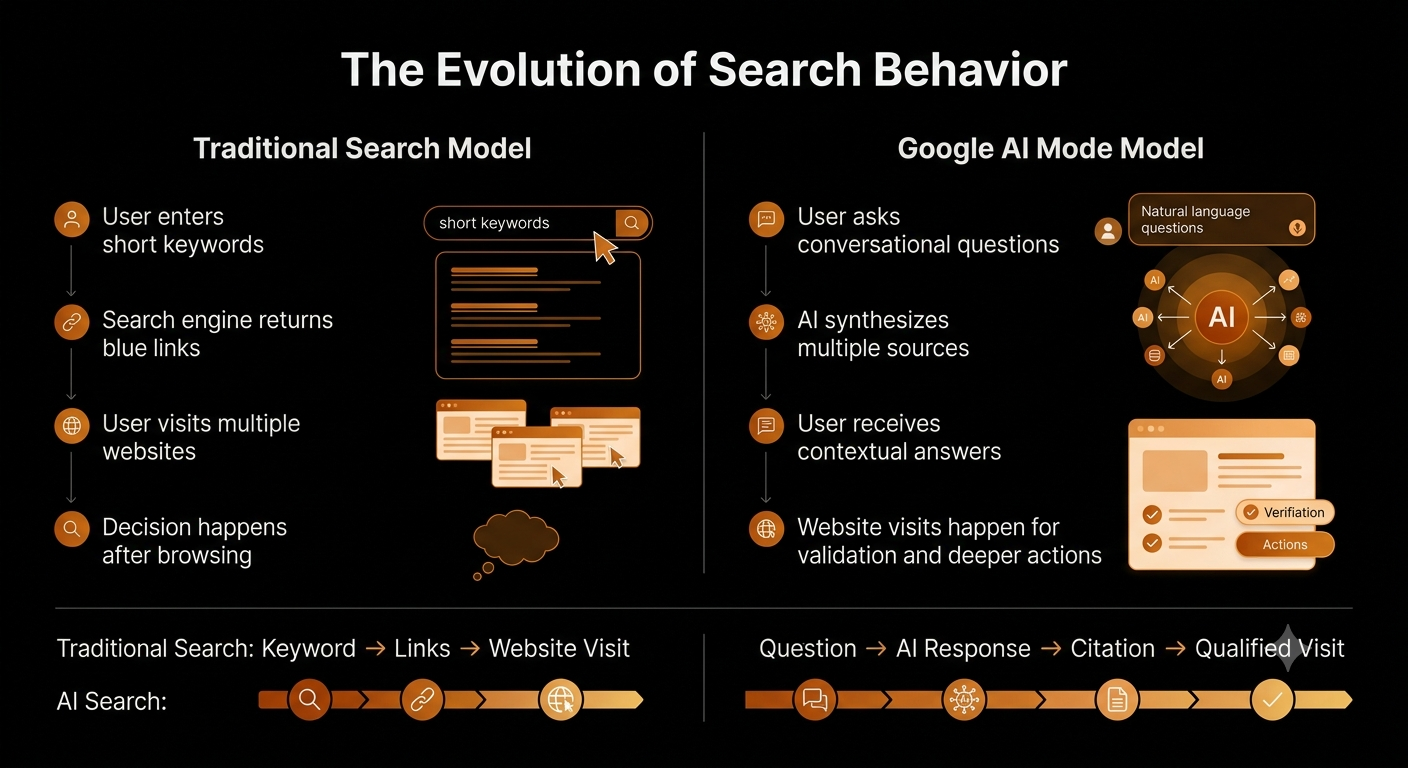
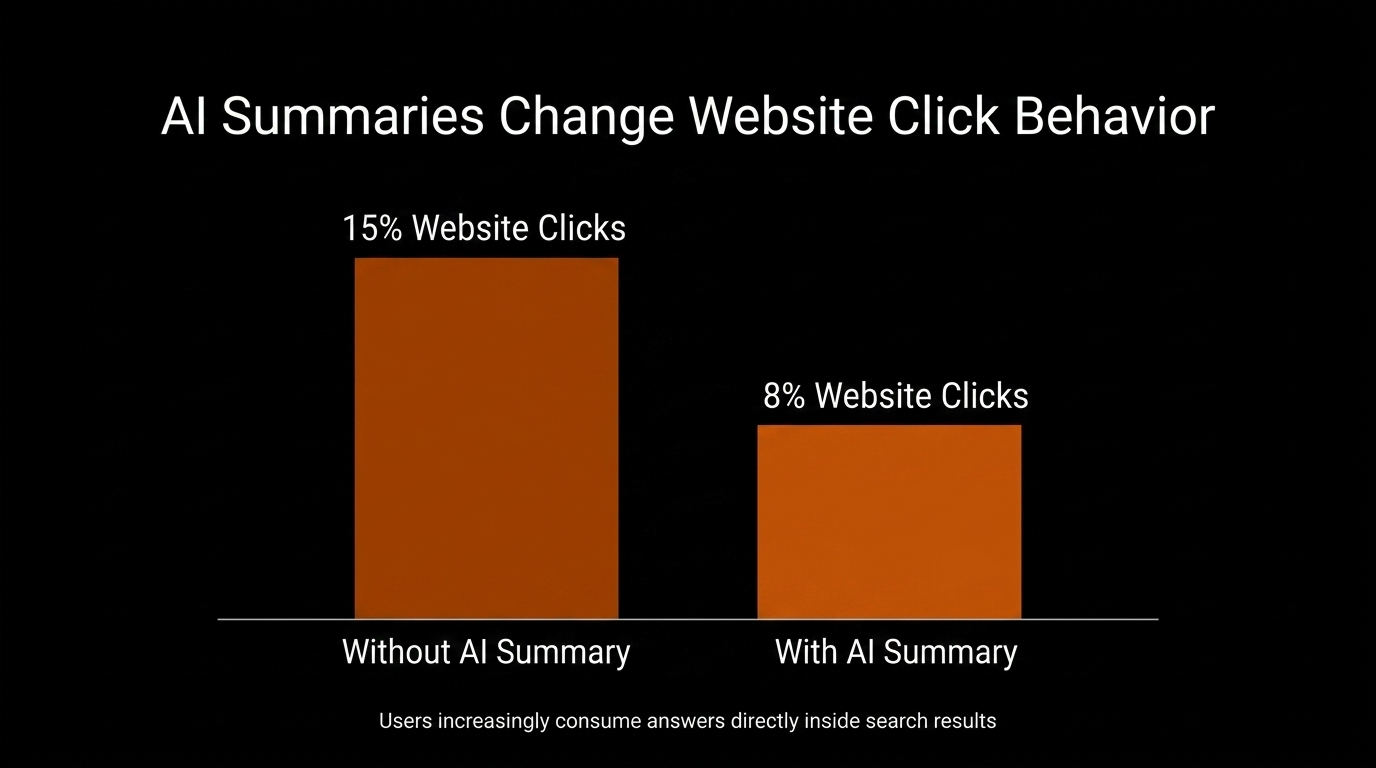
Search visibility in 2026 increasingly involves both traditional search results and AI-mediated discovery experiences. Search engines and answer systems must understand not only individual pages but also entities, relationships, topical depth, business attributes, and information structure.
Modern SEO Optimization Services should therefore address technical accessibility, semantic architecture, structured data, content clusters, entity consistency, internal linking, crawl efficiency, and measurable search demand.
A strong semantic strategy creates clear entity-attribute-value relationships. A service page, for example, should communicate what the service is, who it serves, which problems it addresses, how it operates, and how it relates to adjacent expertise across the website.
Effective SEO Optimization Services also require coordination with developers and content teams. Schema markup, rendering behavior, page performance, indexation controls, information architecture, canonicalization, and content quality cannot be managed effectively as isolated marketing tasks.
Search optimization has become part of digital architecture.
Unlocking Market Expansion via Unique Marketing Services
Technology investments create value only when businesses can convert operational capability into customer acquisition, retention, and revenue.
Well-designed unique marketing services can coordinate paid media, search, content, social distribution, lifecycle email, remarketing, conversion optimization, customer segmentation, and campaign analytics around specific commercial objectives.
The objective is not simply to increase campaign volume. Businesses need channel strategies that reflect customer behavior at different stages of discovery and decision-making.
For example, search may capture existing demand while social platforms create awareness, email nurtures known prospects, remarketing reconnects with previous visitors, and CRM data improves segmentation.
Effective unique marketing services connect these channels with the underlying technology stack so that campaign activity produces usable customer intelligence. Marketing then becomes a measurable operating system rather than a collection of disconnected promotions.
Audit and Upgrade Your Digital Growth Engine
Your next stage of growth may not require more software. It may require a stronger connection between the tools, infrastructure, brand systems, customer data, and marketing channels you already use.
We help businesses assess their digital stack, identify integration and performance gaps, and build a clearer architecture for scalable growth across web development, branding, SEO, automation, and digital marketing.
Ready to evaluate whether your current digital stack is built for 2026 growth? Contact us for a Digital Growth Architecture Review.