Back to Blogs
For nearly three decades, front-end engineering has focused on one primary objective presenting information effectively to human visitors. Performance optimization, responsive layouts, accessibility, and visual consistency have defined successful Web Development practices. While these priorities remain essential, a new audience is becoming equally influential: artificial intelligence.
AI Browsers are changing how digital content is discovered, interpreted, and recommended. Instead of evaluating a page primarily through rendered visuals, these systems prioritize machine-readable content, semantic relationships, structured data, and document hierarchy. The browser is no longer serving only a human interface. It is becoming an interface for language models that retrieve, summarize, and cite information on behalf of users.
This evolution introduces a new architectural challenge for every web developer. Websites must continue delivering excellent user experiences while exposing content that autonomous agents can efficiently interpret. Modern front-end architecture is no longer measured only by rendering speed or visual polish. It is increasingly evaluated by how effectively artificial intelligence systems can extract reliable knowledge.
Organizations that recognize this shift early will have an advantage as AI-assisted browsing continues to influence software discovery, product research, technical documentation, and enterprise purchasing decisions.
The New Gatekeepers: What are AI Browsers?
AI Browsers represent a new category of browsing experience where large language models become the primary interface between users and web content. Instead of returning a collection of hyperlinks, these systems retrieve relevant information, synthesize multiple sources, and generate contextual answers with supporting citations.
Platforms such as Perplexity, OpenAI’s browsing experiences, and Arc Max illustrate this transition. Although their implementations differ, they share a common objective: understanding web content semantically rather than visually. Their retrieval pipelines prioritize clean document structures, explicit relationships between entities, and content that can be parsed efficiently before reasoning begins.
For a web developer, this changes the optimization target. Traditional search engines invested heavily in rendering JavaScript and evaluating visual page experiences. AI Browsers often retrieve information through specialized crawlers, retrieval systems, or cached indexes before language models generate responses. As a result, semantic clarity becomes equally important as visual presentation.
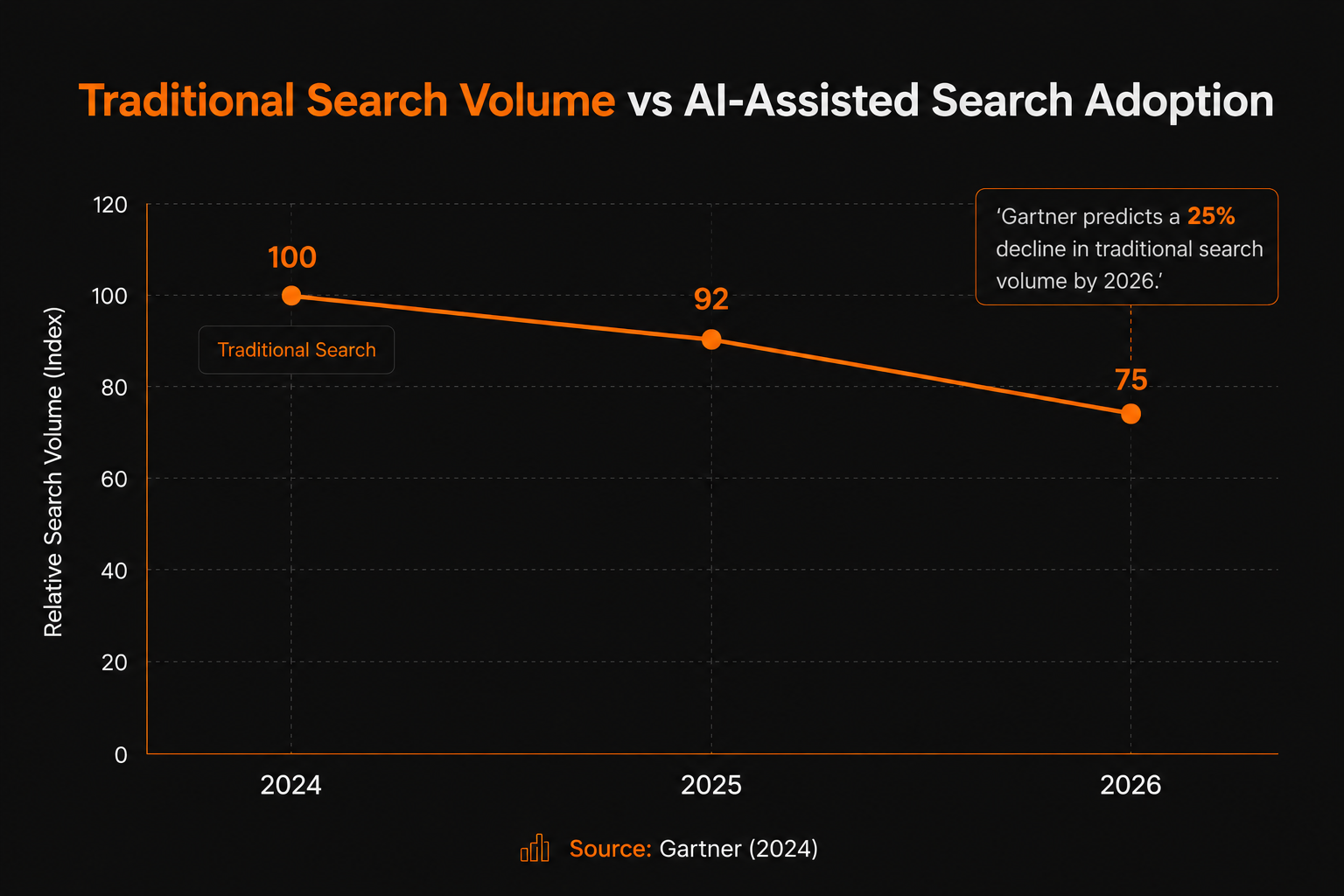
Industry analysts expect this behavioral shift to accelerate. Gartner predicts that traditional search engine volume will decline by 25 percent by 2026 as users increasingly rely on AI chatbots and virtual agents for information retrieval. This projection reflects changing user behavior rather than the disappearance of conventional search, highlighting why technical teams should prepare their digital platforms for both ecosystems. (Source: Gartner)
The Rendering Crisis: Client-Side JavaScript vs. Static HTML
Single Page Applications have become a standard architectural choice because they enable highly interactive user experiences. Frameworks such as React, Vue, Angular, and Next.js support sophisticated interfaces that execute significant portions of application logic within the browser.
However, AI retrieval systems frequently operate under different constraints than traditional browsers. Their objective is not to recreate a complete visual experience. Instead, they prioritize rapid extraction of reliable textual information while minimizing computational overhead.
Recent research conducted by Vercel found that major AI crawlers, including GPTBot, ClaudeBot, PerplexityBot, and several other AI agents, generally do not execute JavaScript during crawling. Although some download JavaScript assets, they typically analyze only the initial HTML response. Content generated exclusively after client-side hydration may therefore remain unavailable to these systems. (Source: Vercel)
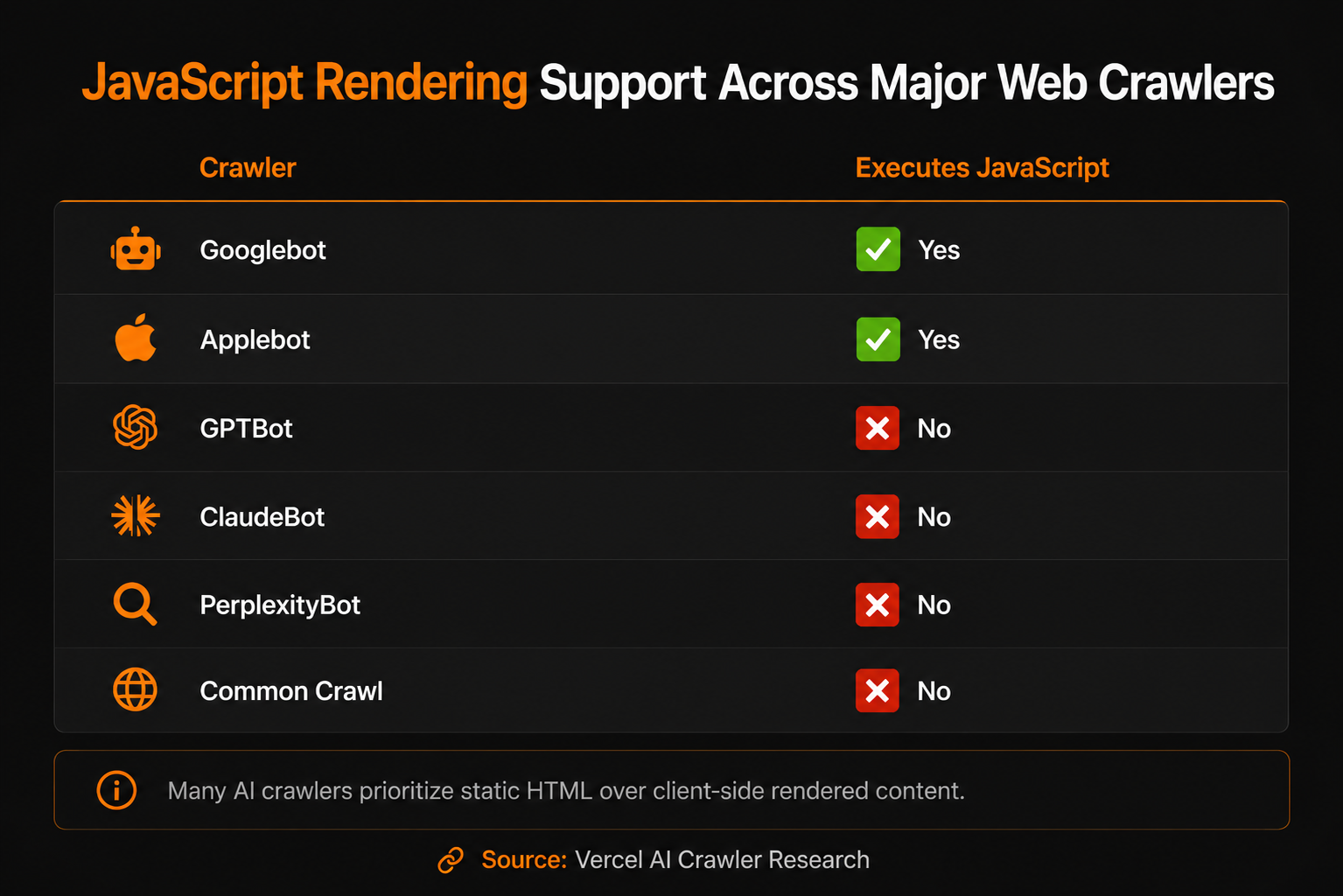
Google Search has gradually improved its JavaScript rendering capabilities, but Google also recommends server-side rendering or static rendering instead of relying on dynamic rendering as a long-term solution. The guidance also notes that other search engines may ignore JavaScript-generated content entirely, creating inconsistencies across indexing systems. (Source: Google Search Central)
For enterprise Web Development teams, this creates an architectural decision rather than a simple SEO adjustment. Critical business information should exist within the initial HTML document whenever possible. Server-side rendering, static site generation, and progressive enhancement improve accessibility not only for traditional search engines but also for emerging AI Browsers.
Why Semantic HTML and JSON-LD Schema are Non-Negotiable
Language models are fundamentally text-processing systems. Before reasoning occurs, retrieved content is typically normalized into machine-readable representations that emphasize structure over visual styling. Headings, paragraphs, lists, tables, and explicit semantic relationships become significantly easier to interpret than deeply nested presentation-oriented markup.
This explains why semantic HTML has become increasingly valuable. Elements such as <article>, <section>, <header>, <main>, <nav>, <aside>, <figure>, and properly nested heading hierarchies provide contextual signals that generic <div> containers cannot communicate effectively.
Unstructured layouts commonly referred to as “div soup” force retrieval systems to infer document hierarchy from presentation patterns rather than explicit semantics. Every additional inference increases ambiguity and reduces extraction efficiency.
Structured data extends this advantage. JSON-LD enables websites to define organizations, products, services, authors, FAQs, events, software applications, and many other entities using standardized vocabularies. Although language models may not directly consume JSON-LD during every retrieval workflow, structured data improves entity understanding across search ecosystems and strengthens knowledge graph associations that influence downstream retrieval.
For the modern web developer, semantic markup should no longer be viewed as an accessibility enhancement alone. It has become a foundational requirement for machine-readable architecture that supports both search indexing and artificial intelligence retrieval systems.
Engineering for Zero-Click Search and Citation Share
Search visibility is no longer measured only by rankings and click-through rates. AI Browsers increasingly answer questions directly, reducing the need for users to visit multiple websites. This shift places a new metric at the center of technical SEO: citation share.
Citation share refers to how frequently an AI system references a website while generating answers. In Retrieval-Augmented Generation (RAG), the language model retrieves relevant documents before producing a response. The quality, accessibility, and structure of those documents influence whether they are selected as supporting evidence. Google recently confirmed that its generative search experiences use RAG techniques grounded in its core Search index, reinforcing that strong technical SEO remains fundamental for AI visibility. (Source: Google Search Central)
For a web developer, improving citation share starts with creating pages that answer specific questions with clear factual statements, logical hierarchy, and verifiable evidence. Dense marketing copy often performs poorly because retrieval systems prioritize extractable information. Definitions, technical explanations, comparison tables, implementation steps, and documented examples are easier for AI systems to retrieve and cite.
Internal linking also requires a different perspective. Instead of treating links solely as navigation, technical teams should use them to reinforce topical relationships. A well-connected knowledge architecture allows crawlers to understand how documentation, service pages, technical guides, and supporting resources relate to one another.
Freshness is another contributing factor. Pages that include updated technical specifications, release notes, version history, and publication dates provide stronger signals for retrieval systems evaluating content reliability. While freshness alone does not guarantee citations, it helps establish relevance when several sources discuss the same subject.
Actionable Optimization Checklist for Web Development Teams
Preparing websites for AI Browsers requires architectural improvements rather than isolated SEO adjustments. Enterprise engineering teams should incorporate machine readability into their standard development lifecycle.
- Adopt Server-Side Rendering (SSR) or Static Site Generation (SSG) for pages containing business-critical information.
- Deliver meaningful content within the initial HTML response instead of relying exclusively on client-side rendering.
- Use semantic HTML elements consistently across templates, including <main>, <article>, <section>, <header>, <nav>, and properly nested heading structures.
- Implement JSON-LD structured data for organizations, products, services, articles, FAQs, software applications, and authors where appropriate.
- Design API-first content systems so structured information can be reused consistently across websites, applications, and AI retrieval pipelines.
- Maintain XML sitemaps and logical internal linking to strengthen crawl efficiency.
- Configure robots.txt carefully for AI crawlers. Review crawler documentation before blocking or allowing specific AI agents, since different vendors use different user agents and retrieval mechanisms. (Source: Google Search Central).
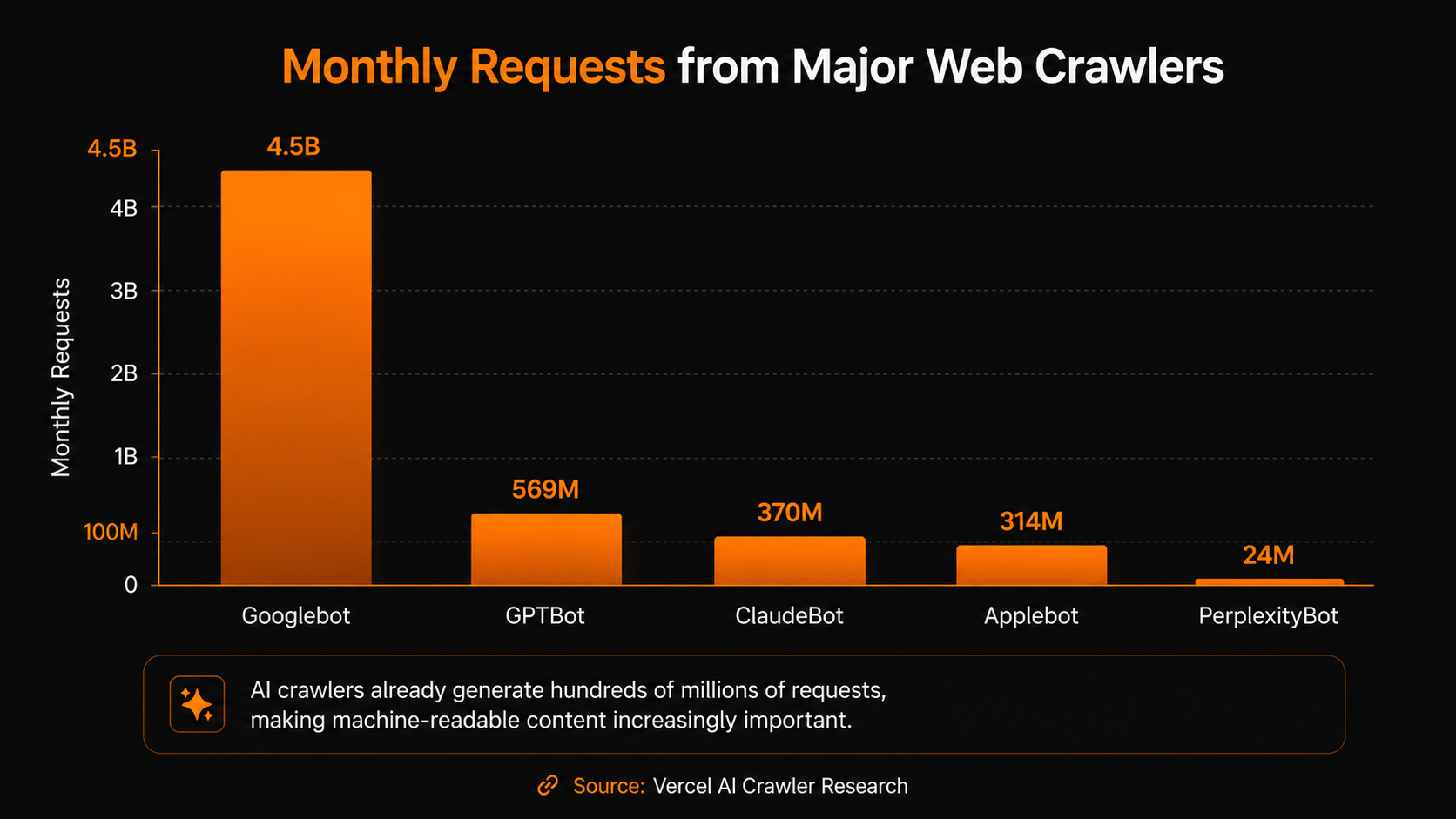
- Monitor server logs to understand activity from Googlebot, GPTBot, ClaudeBot, PerplexityBot, and other AI crawlers. Log analysis often reveals crawling patterns that traditional analytics platforms cannot capture.
- Track structured data validation, Core Web Vitals, crawl status, and indexing health using enterprise monitoring tools alongside traditional SEO reporting.
These practices strengthen both conventional search visibility and AI-driven discovery without creating separate optimization workflows.
The Future of Web Architecture in the Agentic Era
Browsers are evolving beyond interfaces that simply render websites. They are becoming execution environments for autonomous software agents capable of researching products, comparing vendors, summarizing documentation, completing workflows, and making recommendations with minimal human interaction.
This transition changes the role of Web Development. Front-end architecture must now satisfy two audiences simultaneously: people navigating visual interfaces and intelligent systems retrieving machine-readable knowledge. Success will depend on how effectively websites expose structured, reliable, and context-rich information that automated agents can interpret without ambiguity.
Artificial intelligence will also influence application architecture itself. Agentic systems increasingly interact with APIs, structured datasets, documentation portals, and authenticated business platforms rather than only consuming rendered web pages. Organizations that publish consistent schemas, stable APIs, and well-structured documentation will be easier for these systems to understand and integrate into automated workflows.
Current research on Generative Engine Optimization also suggests that citation decisions depend heavily on topical relevance, structured content, completeness, and extractable evidence rather than formatting alone. As AI search platforms mature, engineering decisions will increasingly influence whether content is selected as supporting evidence during answer generation. (Source: arXiv)
The next generation of enterprise websites will not be evaluated solely by page speed, responsive layouts, or visual quality. They will also be assessed by how efficiently autonomous systems can crawl, retrieve, understand, verify, and cite their content. For every web developer and technical leader, machine-readable architecture is becoming a fundamental engineering requirement rather than a specialized SEO consideration.
Build Your Website for the AI-Driven Future
AI Browsers are changing how users discover information and how digital platforms earn visibility. Websites need to be built with structured content, strong architecture, and machine-readable foundations.
If you want to evaluate whether your website is ready for AI-driven discovery, our Web Development team can help identify technical gaps and build a stronger foundation for the next generation of search.
Connect with our experts today and prepare your website for the future of AI-powered browsing.