Back to Blogs
Google AI Mode and the Paradigm Shift in Digital Discovery
For over two decades, Google Search has revolved around a familiar interaction model. Users entered a query, reviewed a page of ranked links, compared multiple websites, and decided where to click. That behavior established the foundation for modern search engine optimization, content marketing, and digital acquisition strategies.
Google AI Mode introduces a fundamentally different experience. Instead of presenting links as the primary destination, Search now generates conversational responses using Gemini, allowing users to ask follow-up questions, upload images, and refine complex requests without restarting the search process. The interface is designed to reason across multiple sources while maintaining conversational context, reducing the friction traditionally associated with information discovery.
For businesses, this change extends well beyond another search feature. Visibility is increasingly influenced by whether Google’s AI systems can interpret, verify, and reference a company’s digital assets during response generation. Rankings remain important, but they now exist alongside entity recognition, structured content, topical authority, and technical accessibility.
This transition also changes how organizations should evaluate digital performance. Measuring success exclusively through keyword rankings or page-level traffic provides an incomplete picture when AI-generated responses satisfy user intent before a click occurs. Businesses must begin assessing citation frequency, entity coverage, and the technical quality of their digital infrastructure alongside traditional SEO metrics.
The organizations that adapt first will treat Google AI Mode as an architectural shift rather than a marketing trend. That requires collaboration between marketing teams, engineering leaders, and decision-makers responsible for digital investment.
How Google AI Mode Alters Consumer Search Behavior
Consumer search behavior has steadily evolved from short keyword phrases toward detailed, conversational questions. Google AI Mode accelerates this pattern by encouraging users to interact naturally, ask follow-up questions, and combine text, voice, and images within a single search journey.
Instead of searching “best CRM software,” users now ask questions such as:
“Which CRM is suitable for a manufacturing company with fewer than 200 employees that already uses Microsoft Dynamics?”
These longer queries require AI systems to synthesize information rather than retrieve a single webpage. As a result, websites compete to become trusted sources within AI-generated answers instead of competing solely for the first organic position.
This behavioral shift also contributes to the continued rise of zero-click search. Users increasingly receive complete answers directly within Google’s interface, reducing the need to visit multiple websites. Industry analysis shows AI-generated search experiences continue to influence click-through behavior, requiring businesses to rethink how they measure organic visibility beyond traditional rankings. (Source: Search Engine Land)
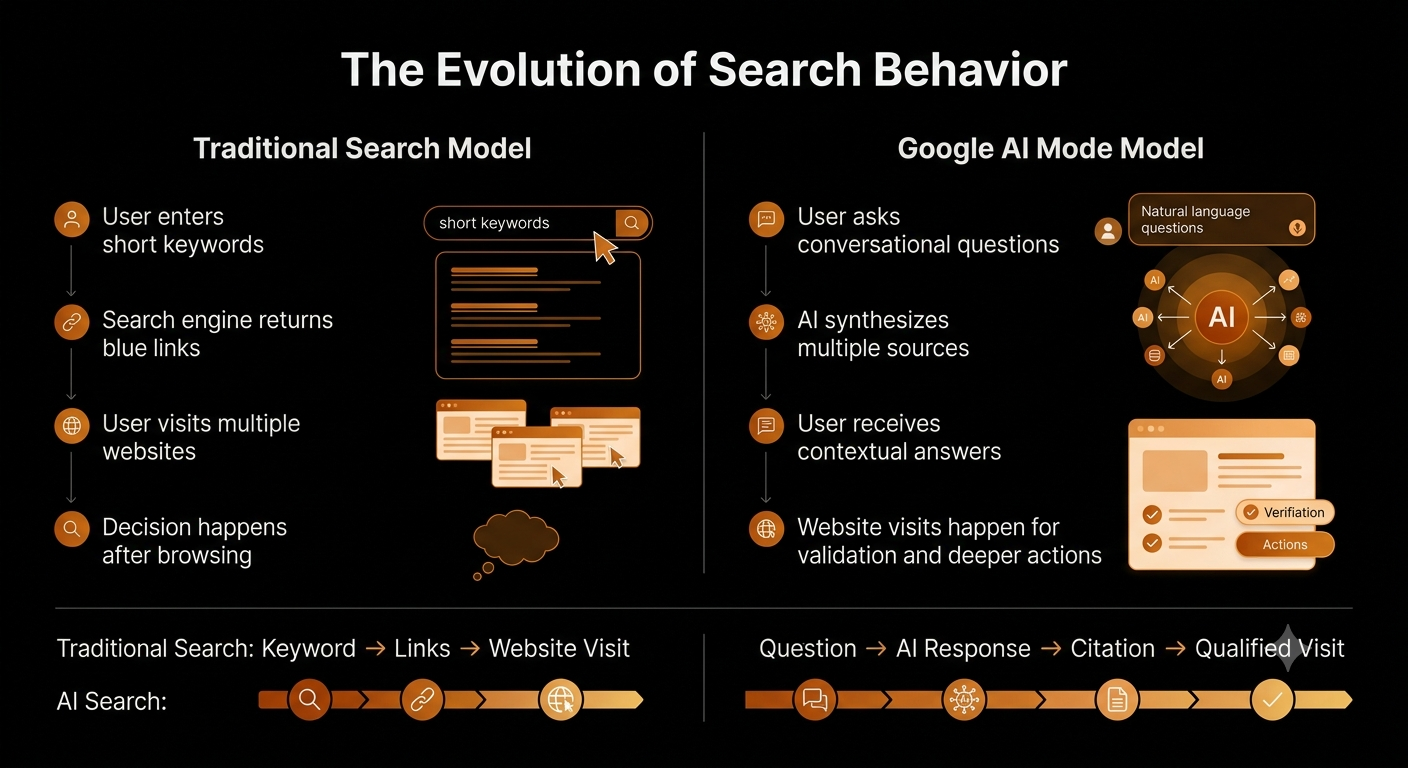
For marketing leaders, the implication is significant. Organic traffic may no longer represent the only indicator of search success. Brands that are consistently cited within AI responses can maintain influence even when total clicks fluctuate. This introduces a broader performance framework centered on discoverability, authority, and information quality.
Businesses should also expect longer customer research cycles conducted almost entirely inside conversational interfaces. AI Mode enables users to compare vendors, summarize technical specifications, evaluate pricing considerations, and refine purchasing criteria before visiting a website. By the time visitors arrive, they are typically seeking validation rather than basic information.
This raises the quality threshold for every digital property. Pages built primarily around keyword density or promotional messaging provide limited value when AI systems prioritize factual accuracy, semantic clarity, and structured information.
Re-Engineering Digital Assets: Why Technical Redesign is Mandatory
Many enterprise websites still reflect architectural decisions made several years ago. Navigation structures have expanded organically, content libraries contain duplicated information, and critical business data is often buried beneath layers of JavaScript or fragmented page templates.
These limitations become increasingly problematic in an AI-driven search environment.
Modern AI retrieval systems evaluate content differently from traditional web browsers. They prioritize structured documents, semantic hierarchy, clearly defined entities, and machine-readable relationships before generating responses. A website that appears visually impressive may still present significant obstacles for AI interpretation if its underlying architecture lacks consistency.
This is why a web design and development agency can no longer evaluate success only through aesthetics or responsive layouts. Technical architecture has become equally important.
Modern website architecture should prioritize:
- Semantic HTML structures
- Server-side rendering where appropriate
- Schema.org structured data
- Logical internal linking
- Clean information hierarchy
- Accessible content delivery
- Stable URL structures
Together, these elements improve both traditional crawling efficiency and AI comprehension.
Legacy websites frequently rely on disconnected landing pages created for individual marketing campaigns. While these pages may satisfy short-term acquisition goals, they often weaken topical relationships across the broader website. AI systems perform better when they can understand how services, expertise, products, documentation, and supporting resources connect within a coherent knowledge structure.
For organizations evaluating long-term competitiveness, a technical audit should precede visual improvements. A successful website redesign is no longer limited to updating branding or improving navigation. It requires rebuilding the underlying information architecture so both users and AI systems can interpret content efficiently.
Businesses investing in digital modernization should therefore consider architecture, taxonomy, structured content, and semantic consistency as strategic priorities rather than secondary development tasks.
The Role of Backend Development in the Age of Conversational Search
Front-end interfaces receive most of the attention during digital projects, yet Google’s AI ecosystem increasingly depends on what happens behind the interface.
Effective backend development determines whether information can be retrieved accurately, updated efficiently, and delivered consistently across search engines, AI assistants, mobile applications, and enterprise platforms.
Google’s AI systems increasingly interact with structured information through APIs, server-rendered pages, schema markup, and standardized content models. When data remains fragmented across disconnected systems, inconsistencies become inevitable. Product information, pricing, author details, FAQs, and documentation should originate from centralized sources rather than multiple manually maintained pages.
Server-side rendering also becomes increasingly valuable for business-critical content. While Google’s rendering capabilities continue to improve, delivering meaningful HTML immediately reduces ambiguity and ensures essential information is accessible before JavaScript execution. Google continues to recommend approaches that prioritize crawlability and accessible content for search systems. (Source: Google Search Central)
API architecture represents another strategic consideration.
Organizations increasingly publish information across websites, customer portals, mobile applications, AI assistants, and internal knowledge systems simultaneously. API-first infrastructure allows structured content to remain synchronized regardless of where users or AI systems access it.
Backend teams should also monitor crawler activity beyond Googlebot. AI crawlers, retrieval systems, and emerging agentic browsers each interact differently with digital properties. Log analysis provides valuable insight into how these systems consume content, identify technical bottlenecks, and prioritize crawling resources.
For executive leadership, backend modernization is no longer simply an operational improvement. It directly influences discoverability, information accuracy, and the organization’s ability to participate effectively in Google’s evolving AI search ecosystem.
Engineering for Zero-Click Search and Citation Share
Search visibility is no longer measured only by rankings and click-through rates. AI Browsers increasingly answer questions directly, reducing the need for users to visit multiple websites. This shift places a new metric at the center of technical SEO: citation share.
Citation share refers to how frequently an AI system references a website while generating answers. In Retrieval-Augmented Generation (RAG), the language model retrieves relevant documents before producing a response. The quality, accessibility, and structure of those documents influence whether they are selected as supporting evidence. Google recently confirmed that its generative search experiences use RAG techniques grounded in its core Search index, reinforcing that strong technical SEO remains fundamental for AI visibility. (Source: Google Search Central)
For a web developer, improving citation share starts with creating pages that answer specific questions with clear factual statements, logical hierarchy, and verifiable evidence. Dense marketing copy often performs poorly because retrieval systems prioritize extractable information. Definitions, technical explanations, comparison tables, implementation steps, and documented examples are easier for AI systems to retrieve and cite.
Internal linking also requires a different perspective. Instead of treating links solely as navigation, technical teams should use them to reinforce topical relationships. A well-connected knowledge architecture allows crawlers to understand how documentation, service pages, technical guides, and supporting resources relate to one another.
User Experience in an AI-First World: Adapting UX Design Strategies
Google AI Mode changes not only how users discover websites but also how they arrive. Many visitors will reach a website after receiving an AI-generated summary, product comparison, or recommendation. They often arrive with greater context and clearer intent than users following a traditional search journey.
This shift requires every UX designer to rethink conventional user journeys. Instead of assuming visitors begin on the homepage, experiences should support entry through service pages, documentation, pricing pages, comparison content, and knowledge resources. Every landing page should function as an independent destination capable of answering questions without relying on extensive navigation.
Content hierarchy also becomes increasingly important. AI-assisted visitors expect immediate confirmation that they have reached the correct resource. Clear headings, concise summaries, logical information architecture, and visible trust signals reduce friction while helping users continue their decision-making process.
The role of UX is expanding beyond interface aesthetics. Designers should create experiences that support both human understanding and machine interpretation. Structured content, accessible navigation, meaningful labels, and consistent page patterns improve usability while also strengthening AI retrieval.
Industry research reflects this behavioral shift. A 2025 Pew Research Center study found that when AI-generated summaries appeared in Google Search, users clicked on source websites only 8% of the time, compared with 15% when no AI summary was shown. This indicates that websites increasingly serve visitors who have already completed much of their research before arriving. (Source: Pew Research Center)
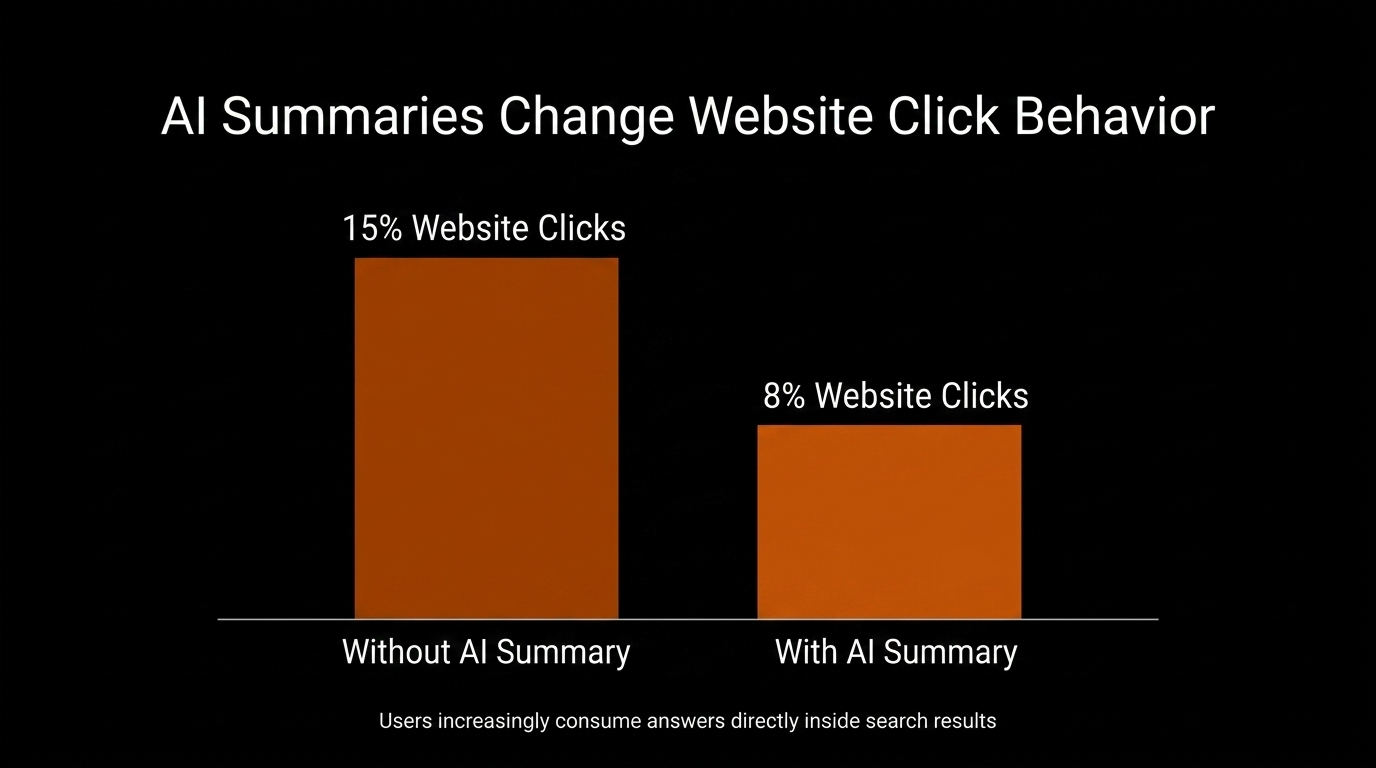
For businesses, success increasingly depends on reducing the effort required to validate information, request demonstrations, compare solutions, or contact decision-makers. Every interaction should reinforce clarity and confidence rather than require additional exploration.
Strategic Imperatives for Businesses Considering a Website Redesign
A cosmetic refresh is no longer sufficient in an environment where AI systems evaluate websites alongside human users. Organizations considering a website redesign should view the initiative as an opportunity to modernize architecture, improve content governance, and strengthen technical foundations.
The first priority is information architecture. Content should be organized around business entities, products, services, industries, and customer problems rather than isolated marketing campaigns. AI systems perform better when relationships between topics are explicit and consistently structured.
The second priority is technical modernization. Server-side rendering, semantic HTML, structured data, optimized Core Web Vitals, XML sitemaps, and crawlable navigation help Google interpret information accurately while improving user experience.
Content strategy should also evolve. Pages that answer specific business questions, explain technical capabilities, compare solutions, and provide verifiable evidence are increasingly valuable within AI-powered search environments. Promotional language alone contributes little to AI retrieval quality.
A professional web design and development agency should therefore approach redesign projects with cross-functional collaboration between strategists, developers, SEO specialists, infrastructure teams, and content architects. This integrated approach reduces technical debt while creating digital assets that remain adaptable as Google’s search experience continues to evolve.
Organizations delaying modernization may continue to perform adequately in traditional search, yet gradually lose visibility within conversational AI experiences that increasingly influence enterprise purchasing decisions.
The Future of Digital Marketing in an Ecosystem Powered by Artificial Intelligence
Google AI Mode represents a broader evolution in how digital visibility is earned. Search optimization is expanding beyond keyword relevance toward entity authority, structured knowledge, and content quality that AI systems can interpret with confidence.
Digital marketing strategies will therefore become increasingly connected with engineering decisions. Technical architecture, structured data, API consistency, documentation quality, and content governance all contribute to whether an organization becomes a trusted source during AI-assisted search.
Marketing teams will also rely on new performance indicators. Citation frequency, entity coverage, assisted conversions, branded search growth, and AI referral traffic will complement traditional metrics such as rankings and click-through rates.
Google continues to emphasize that AI-powered Search is designed to help users ask longer, more complex questions while connecting them with useful web content. Businesses that publish accurate, well-structured information are therefore better positioned to remain visible as search experiences continue evolving.
Forward-looking organizations will treat AI readiness as an ongoing capability rather than a one-time optimization project. Continuous improvements to content quality, technical infrastructure, and digital governance will play an increasingly important role in maintaining visibility across Google’s evolving search ecosystem.
Preparing Your Business for Google AI Mode
Google AI Mode is changing how businesses earn visibility across Search. As AI becomes a larger part of the discovery journey, websites need to do more than rank well. They must provide structured, accessible, and technically reliable information that AI systems can understand, reference, and present with confidence.
If your website has not been evaluated recently, now is the right time to assess whether its architecture, content structure, and technical foundation are prepared for AI-powered search experiences. A strategic review can identify opportunities to improve discoverability, strengthen technical performance, and support long-term organic visibility as Google Search continues to evolve.
Ready to prepare your business for Google AI Mode?
Connect with our team to evaluate your website architecture, identify technical gaps, and build a future-ready digital foundation for the next generation of search.