Back to Blogs
Beyond the Blue Links: Why Google’s AI Search Demands a New Content Strategy
For two decades, digital visibility followed a familiar model: search engines displayed ranked links, users clicked through to websites, and brands measured success through impressions, traffic, and conversions. That framework is changing rapidly.
Google’s introduction of AI Overviews and conversational search experiences has shifted search from a discovery system to an answer system. Instead of presenting ten links and asking users to evaluate them, Google increasingly synthesizes information directly within the results page. AI-generated summaries, contextual follow-up questions, and multi-source answers now occupy valuable screen space that once belonged to traditional organic listings.
This change is not a temporary interface update. It represents a structural shift in how information is retrieved, interpreted, and delivered. Visibility is no longer determined solely by ranking position. Businesses must now consider whether their content can be understood, trusted, and cited by AI systems.
For business leaders, CMOs, and digital strategists, this introduces a new challenge content strategies designed for traditional Search Engine Optimization may not perform effectively in an environment where AI intermediates the relationship between brands and audiences.
The organizations that adapt first will not simply produce additional content. They will build structured information ecosystems supported by a modern content management system, advanced Search Engine Optimization practices, and professional web development that enables both search engines and AI models to interpret information efficiently.
The Devaluation of Keyword-Stuffed Content and the Rise of GEO
Early SEO practices often rewarded repetition. Pages that matched keywords aggressively could secure visibility, even if they provided limited informational value. AI-driven search systems operate differently.
Google’s AI experiences evaluate content based on topical depth, entity relationships, credibility, context, and usefulness. A page that answers a question clearly and connects related concepts has greater potential to appear in AI-generated responses than a page built primarily around keyword frequency.
This evolution has accelerated interest in Generative Engine Optimization (GEO), an emerging discipline focused on increasing visibility within AI-generated answers, summaries, and conversational interfaces. GEO extends beyond rankings and examines how content is selected, cited, and synthesized by large language models.
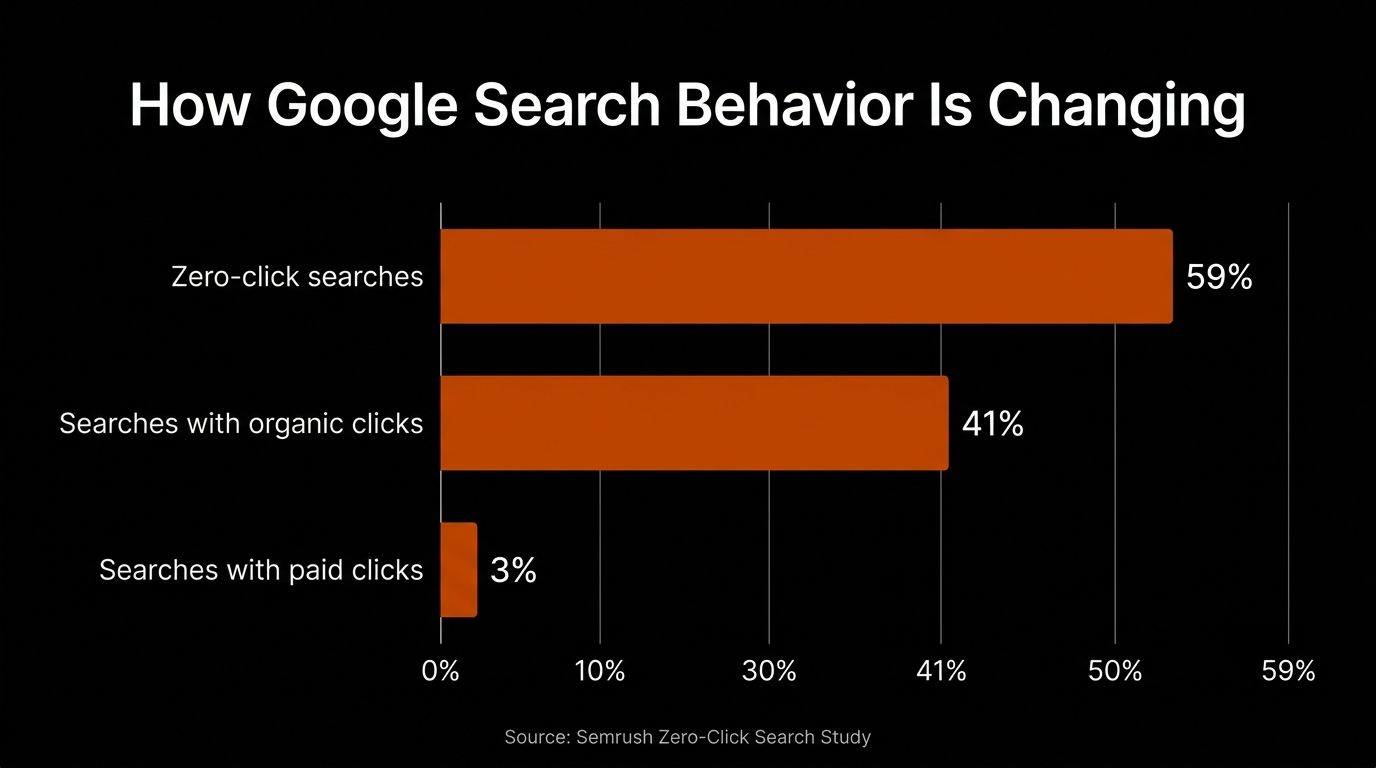
The traffic implications are significant. Recent studies indicate that nearly 60% of Google searches now end without a click, as users obtain answers directly from search features, AI summaries, and knowledge panels. Businesses relying exclusively on traditional traffic models may experience declining organic sessions even when maintaining strong rankings. (Source: Semrush)
User behavior data reveals a similar trend. Research from Pew found that users encountering AI summaries clicked traditional search results in only 8% of visits, compared with 15% when no AI summary appeared. This indicates that AI-generated answers are reshaping how audiences interact with search results. (Source: Pew Research Center)
For content teams, the implication is clear: success now depends on information quality rather than publishing volume. Pages should answer primary questions immediately, provide supporting context, include expert perspectives, and establish clear relationships between concepts.
Content architecture has become as important as content creation.
The Role of a Modern Content Management System in an AI-Driven Ecosystem
The rise of AI search is exposing limitations in many legacy digital platforms.
Traditional websites were often designed primarily for human visitors. Navigation, page layouts, and publishing workflows focused on visual presentation rather than machine readability. AI-driven search introduces a different requirement: content must be understandable to both people and automated systems.
A modern content management system plays a central role in this transition. It serves not only as a publishing platform but as the operational layer through which structured information is created, organized, and distributed.
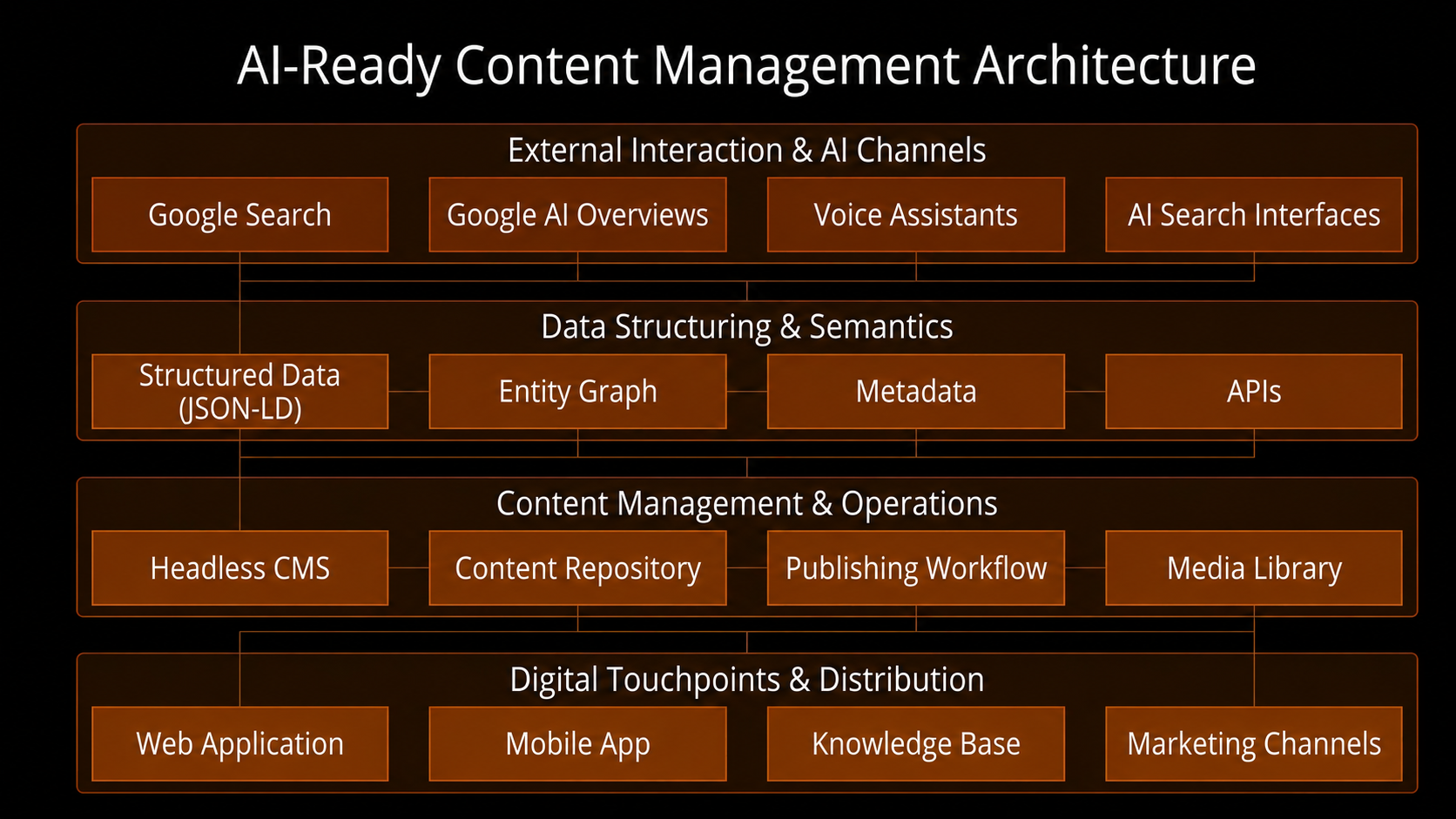
Enterprise organizations increasingly require capabilities such as:
- Native schema markup support
- JSON-LD integration
- API-driven content delivery
- Headless architecture
- Multi-channel publishing
- Centralized entity management
Structured data has become particularly important. Schema markup helps search engines and AI systems interpret authorship, products, services, locations, FAQs, events, and organizational relationships. This additional context increases the likelihood that content can be referenced accurately in AI-generated responses.
Google has also emphasized that AI features rely on existing search systems, meaning technical quality, crawlability, and structured information remain essential for visibility. (Source: Google Search Central)
Headless and API-first architectures are becoming increasingly valuable because they separate content from presentation. This allows organizations to distribute information consistently across websites, mobile experiences, search interfaces, AI systems, voice assistants, and future channels that may emerge.
Performance also matters. AI crawlers process enormous volumes of information and often prioritize accessible, well-structured content. Slow rendering, fragmented information architecture, and inconsistent metadata can reduce discoverability.
A modern content management system therefore becomes a strategic asset rather than a publishing utility. It enables organizations to maintain structured knowledge, accelerate content deployment, and improve machine interpretation across multiple digital environments.
As search evolves toward answer-first experiences, businesses must think beyond webpages and begin managing information as a connected ecosystem.
Evolving Search Engine Optimization: From Traffic Acquisition to Entity Authority
Search Engine Optimization is entering a new phase.
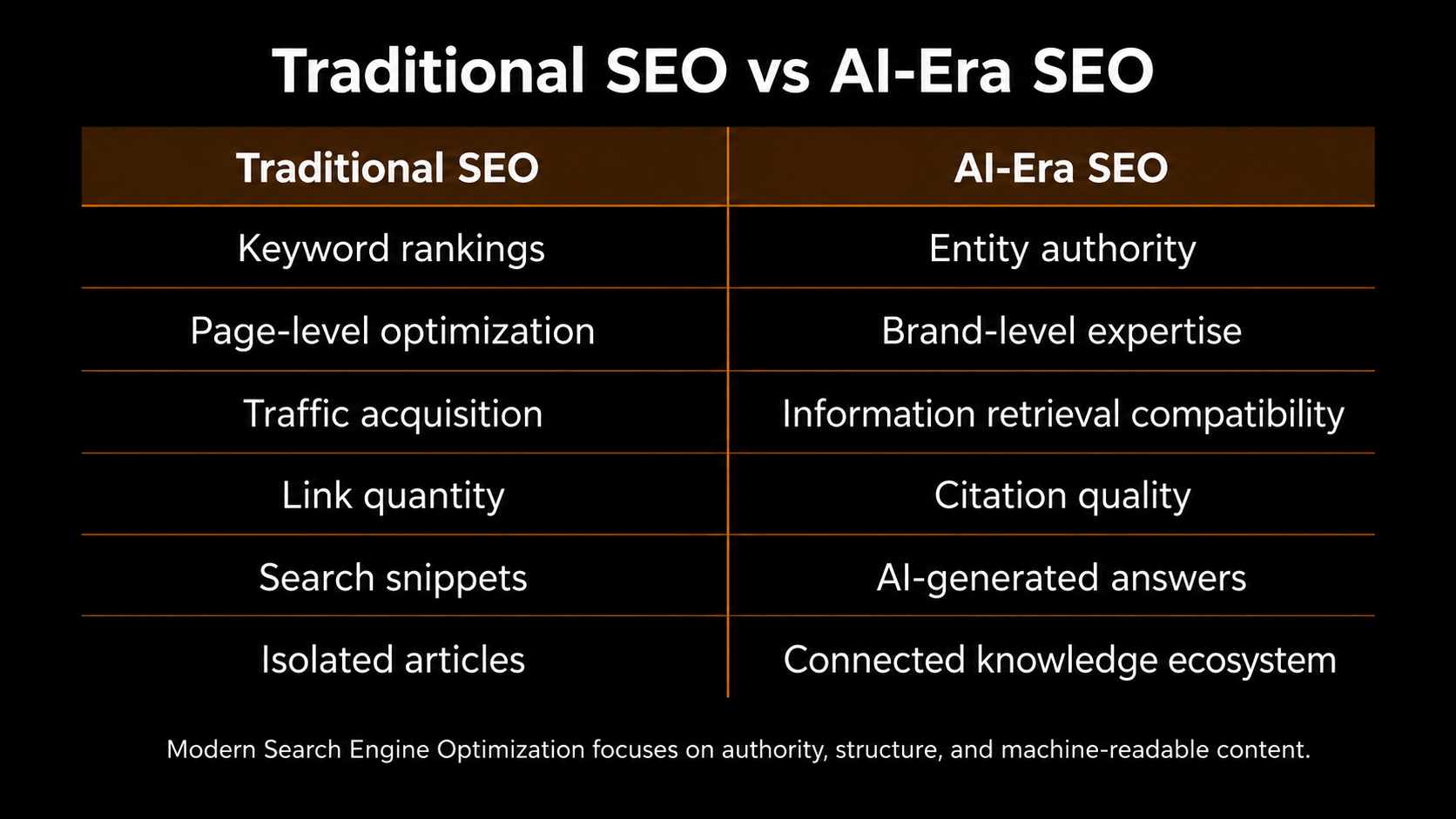
Historically, SEO focused heavily on rankings, keywords, and page-level performance. While these fundamentals remain relevant, AI-driven search systems increasingly evaluate organizations as entities rather than collections of individual pages.
An entity-based approach examines relationships between brands, authors, products, industries, locations, and expertise. AI models seek signals that indicate credibility, authority, and consistency across the web.
This shift changes how organizations should think about visibility. A company cited across industry publications, supported by expert authors, reinforced through structured data, and associated with clearly defined areas of expertise is more likely to be referenced in AI-generated experiences.
Research into AI search behavior has found that AI-generated answers frequently cite sources that do not necessarily appear in traditional ranking positions, suggesting that retrieval mechanisms are expanding beyond conventional search signals. (Source: arXiv)
For modern Search Engine Optimization, the objective is no longer limited to acquiring traffic. The objective is establishing digital authority that can be understood, verified, and reused by AI systems.
This requires stronger editorial standards, clear authorship, connected content structures, accurate schema implementation, and a web presence that consistently communicates expertise across channels.
Next-Generation SEO Techniques for Modern Brand Visibility
As AI-generated search experiences become increasingly common, successful optimization depends on how effectively information can be interpreted, connected, and cited. Modern SEO Techniques therefore focus on improving knowledge accessibility rather than maximizing keyword frequency.
An answer-first content structure is one of the most effective approaches. Each page should provide a direct response near the beginning, followed by supporting evidence, technical explanations, examples, and related context. This layered format allows both users and AI retrieval systems to identify the primary answer quickly while preserving sufficient depth for complex queries.
Entity mapping has also become a strategic priority. Instead of treating every article as an isolated asset, organizations should connect products, services, industries, authors, technologies, and customer problems through consistent terminology and structured relationships. This creates a stronger knowledge graph that helps AI systems understand how different pieces of information relate to one another.
Modern SEO Techniques should also include multi-modal optimization. Images, diagrams, videos, comparison tables, and technical illustrations provide additional signals that improve content understanding across search platforms. Well-written image descriptions, descriptive filenames, structured metadata, and accessible markup increase the likelihood that visual assets contribute to AI-generated responses.
Google continues to emphasize that foundational Search Engine Optimization practices remain applicable to AI-powered search experiences. Rather than pursuing isolated GEO tactics, organizations should focus on technically sound websites, people-first content, structured data, and clear information architecture because Google’s generative features rely on the same core search systems. (Source: Google Search Central)
Independent industry research also demonstrates why this evolution matters. Studies have reported click-through rate reductions ranging from approximately 34% to 46% when AI summaries appear above traditional organic listings, reinforcing the importance of earning citations within AI responses instead of relying solely on conventional rankings. (Source: Search Engine Journal)
Why Professional Web Development Is Essential for AI Crawlability
Content quality alone cannot compensate for technical limitations. Even the strongest editorial strategy may underperform if AI crawlers encounter slow rendering, inaccessible content, or inconsistent document structures.
Professional web development provides the technical foundation that enables search engines and AI systems to process information efficiently. Modern websites should prioritize server-side rendering where appropriate, minimize unnecessary client-side JavaScript, reduce latency, and maintain a logical Document Object Model (DOM) hierarchy that exposes meaningful content without excessive rendering complexity.
Performance remains closely linked to discoverability. Fast server response times, optimized caching strategies, compressed assets, and efficient code delivery allow crawlers to process pages within limited resource budgets. Websites that require extensive script execution before exposing meaningful content risk delaying or limiting content interpretation.
Semantic HTML also plays a critical role. Proper heading structures, descriptive navigation, accessible markup, and logical page hierarchy improve machine readability while strengthening accessibility for human visitors. Combined with schema markup, these elements create multiple layers of contextual information that support both indexing and AI retrieval.
Professional web development should also include robust API architecture for organizations publishing across multiple digital channels. Whether content appears on websites, mobile applications, knowledge bases, or future AI interfaces, centralized content delivery ensures consistency, reduces duplication, and simplifies governance.
Technical excellence has therefore become a competitive differentiator. Businesses that invest in resilient web architecture position their content for efficient discovery across both traditional search engines and emerging AI-driven experiences.
Audit Your Content Infrastructure for the AI Search Era
Google’s AI-powered search experience is changing how businesses earn visibility online. Ranking well is no longer the only objective. Websites must deliver structured, authoritative, and technically accessible information that AI systems can interpret, evaluate, and reference with confidence.
Now is the right time to evaluate whether your content management system, Search Engine Optimization strategy, and website architecture are prepared for this shift. Identifying technical limitations, strengthening content structure, and improving machine readability today can help protect long-term organic visibility as AI-driven search continues to evolve.
At Osama Arshad Pvt Ltd, we help businesses build future-ready digital ecosystems through strategic content architecture, professional web development, technical SEO, and scalable web solutions. Whether you’re modernizing an existing website or planning a complete digital upgrade, our team can assess your current infrastructure, identify opportunities for improvement, and develop a strategy aligned with the next generation of search. Start the conversation today and prepare your website for an AI-first search landscape.