Back to Blogs
The Evolution from Search Engines to Generative Engines
The architecture of information retrieval has changed. Not incrementally. Completely.
For over two decades, Search Engine Optimization operated on a mechanical contract: produce content containing the right keywords, acquire backlinks from authoritative domains, meet Core Web Vitals thresholds, and the algorithm rewards you with a ranked position. That contract is now void. Google’s 2026 rollout of Unified AI Mode did not add a new feature to search. It replaced the fundamental output model.
In the old pipeline, the user submits a query, receives ten blue links, clicks through to a source, and the website registers a session. Traffic flows. In AI Mode, the user submits a query and receives a synthesized, structured answer generated directly inside the Google interface. The ten blue links have collapsed into a single coherent response. The click-through, in most informational queries, never happens.
This is not a threat to content quality. It is a threat to content discoverability for anyone who has not adapted their technical and semantic infrastructure. Generative Engine Optimization (GEO) is the engineering discipline that replaces traditional SEO in this environment. GEO is not about ranking in a list. It is about being selected as a Preferred Source, the “Highly Cited” label Google’s AI agents attach to brands whose data structures, entity definitions, and authority signals are clean enough to clip, verify, and present inside a generated response.
Websites that survive the shift are not necessarily the most trafficked or the most backlinked. They are the most machine-readable. That distinction is everything.
GEO is not a content strategy. It is a systems engineering problem. The question is not what you are saying. It is whether an LLM parser can extract, verify, and cite what you are saying without ambiguity.
Decoding the Anatomy of a Preferred Source
Google’s AI agents do not browse content the way a human does. They execute probabilistic text comprehension against a document’s parsed DOM and compare extracted claims against internal knowledge graphs and corroborating sources. The selection of a Preferred Source is not editorial. It is statistical and structural.
Several hard criteria govern citation selection.
- First: structural trust. The AI agent must be able to identify who is making a claim, what the claim is, and on what authority the claim rests. Vague phrasing, passive voice, and marketing superlatives (“a leading provider of world-class solutions”) score near zero on the semantic clarity index used by transformer-based retrieval pipelines. The agent cannot confidently attribute the claim, so it discards it and moves to a source that writes in direct declarative statements.
- Second: direct factual assertions. AI Mode’s retrieval layer is built on information gain scoring, not keyword density. A page that defines a concept explicitly, with named entities, precise figures, and verifiable technical specifics, accumulates high information gain scores. A page that discusses the “importance of leveraging synergies in an ever-evolving space” scores nothing. The LLM parser has no extractable claim to work with.
- Third: clean infrastructure. A brand’s data buried behind heavy JavaScript rendering, inside dynamic modal popups, or nested seven layers deep in a component tree is functionally invisible to the AI crawler’s default parsing pass. The crawler does not execute complex client-side rendering by default. If your core authority signals (founding date, specialization domain, service definitions, technical certifications) live inside a JavaScript bundle, they are being missed.
| Signal | Traditional | GEO |
|---|---|---|
| Keyword density | High | Near zero. Replaced by information gain score. |
| Backlink volume | High | Moderate. Entity corroboration matters more than raw link count. |
| Semantic HTML structure | Low to moderate | Critical. Determines parse reliability in low-render environments. |
| Explicit entity schema (JSON LD) | Helpful | Primary trust signal for Knowledge Graph linkage. |
| Direct factual definitions | Content strategy | Core citation driver. Definition blocks are the atomic unit of GEO. |
Technical Framework:
Preparing Your Site Architecture for GEO
Architecture changes before content changes. A site with perfect prose but broken entity infrastructure will not be cited. Below is an engineering blueprint for restructuring a web property to perform under AI Mode selection criteria.
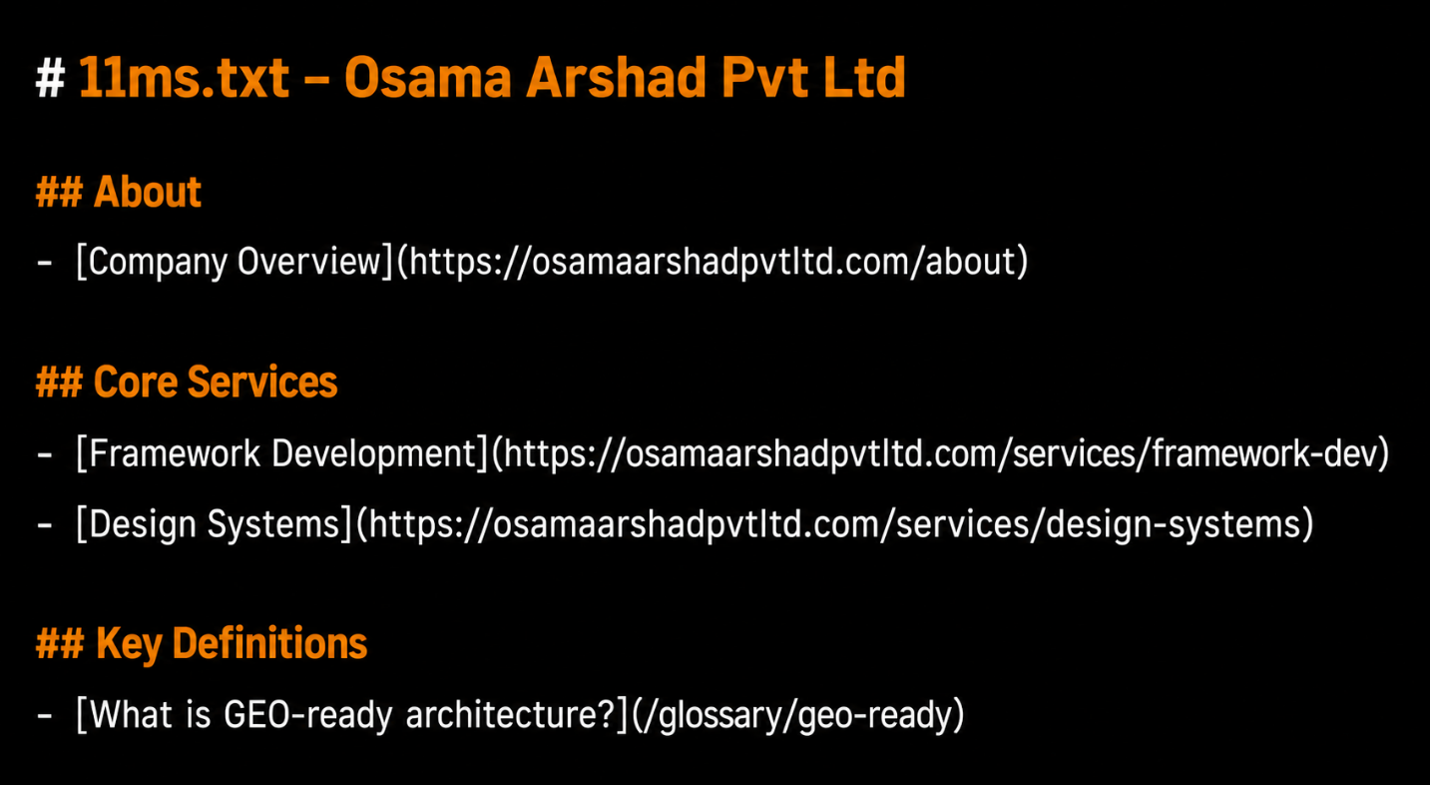
1. Implement the llms.txt Standard
Deploy a plain-text file at your root directory: yourdomain.com/llms.txt. This file is not a robots.txt clone. It is an explicit directory of your highest-priority entity data, written in clean Markdown, designed specifically to guide AI crawlers toward the pages and definitions you want cited. It should contain direct links to your About page, core service definitions, founder entity data, and any published technical documentation. Keep it under 2,000 tokens. The LLM parser loads this file first during an entity resolution pass. If the file does not exist, the crawler must infer priority from DOM structure, which introduces noise and reduces citation probability.
2. Semantic HTML and DOM Simplification
Reduce DOM depth. A parser trying to extract the main claim of a page should not have to navigate through fourteen nested div elements to reach an h1. Use strict semantic tags: <article>, <section>, <aside>, <main>, <header>. These are not decorative. They encode document hierarchy that LLM scrapers use to determine what is a primary claim versus what is navigational noise. Avoid placing core definitional content inside web components that require JavaScript execution to render their shadow DOM. If the text containing your brand’s core authority statement only appears after a hydration event, it will be missed in a static parse pass.
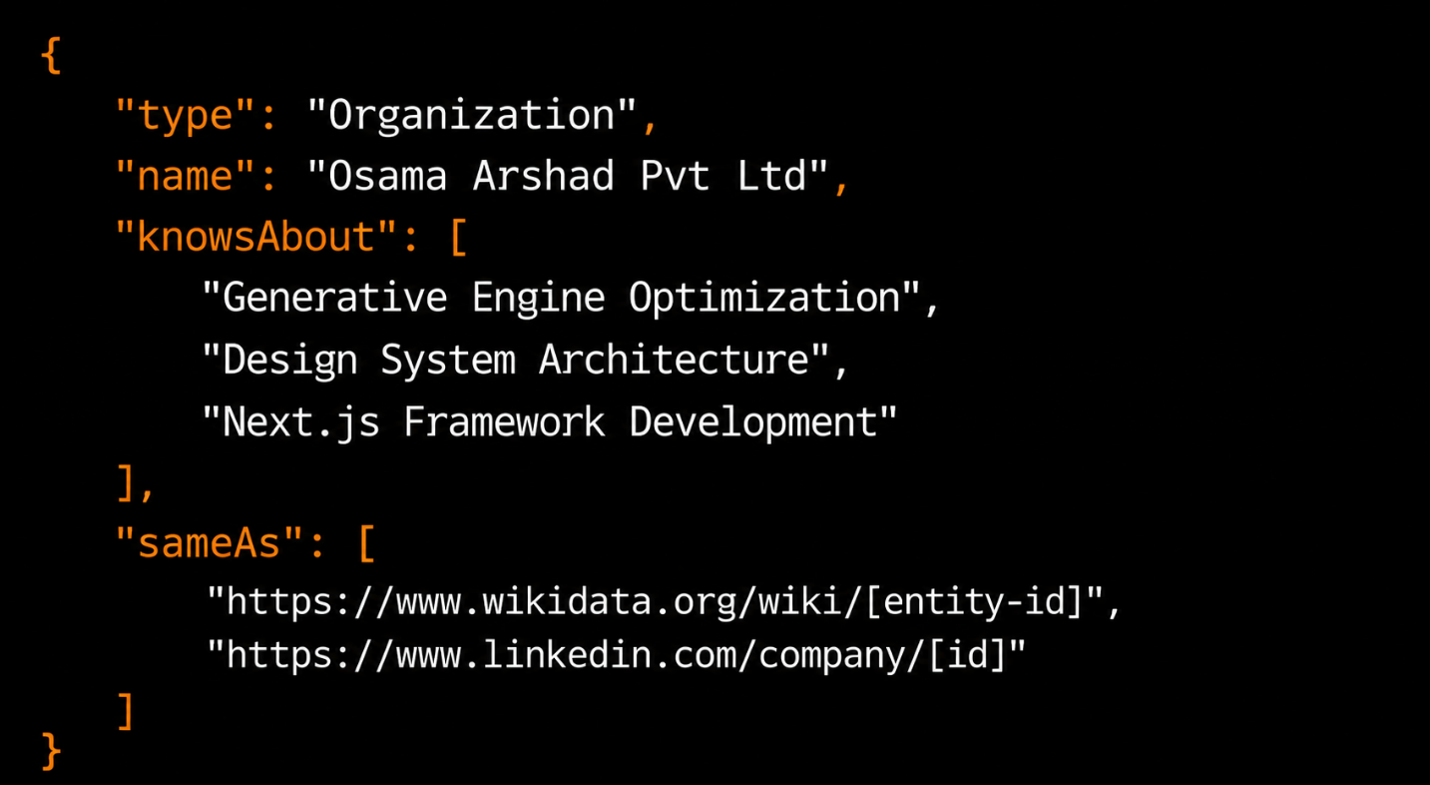
3. Advanced Entity Schema
Stop deploying generic LocalBusiness schema. Implement dense Profile Schema that connects your brand entity directly to established nodes in Google’s Knowledge Graph. For a technology firm, this means using Organization schema with explicit sameAs properties pointing to your Wikidata entity, LinkedIn organization ID, and Crunchbase profile. Include knowsAbout arrays populated with specific technical topics, not categories. Add hasCredential nodes if applicable. The goal is to give Google’s Knowledge Graph enough structured edge connections to treat your brand as a verified, resolvable node rather than an ambiguous string of text that appears on multiple pages.
Optimizing the Content Layer for LLM Citations
Content strategy in GEO is a precision engineering task. Every paragraph should be evaluated by a single question: can an LLM extract a citable, attributable, verifiable claim from this block of text?
Traditional keyword optimization asked: does this page contain the phrase “best web development company”? GEO asks a different question entirely. Does this page contain an explicit, machine-readable definition of what constitutes excellent web development, supported by specific technical criteria, authored under a named entity, corroborated by structured data? That is what gets cited.
The atomic unit of GEO content is the definition block. A definition block is a short, direct paragraph (three to five sentences) that states what something is, how it works, and what makes it distinct, using precise technical language and named entities. No hedging. No qualifiers like “it’s somewhat important to consider.” A flat declarative statement followed by its mechanical explanation.
Tabular data comparisons are high-citation surfaces. AI agents can extract structured rows with high confidence, and the comparative format satisfies the information gain threshold for complex queries. Any content that positions your brand’s approach against an industry norm, expressed in a table with explicit column headers and factual cell values, is a strong citation candidate.
“The question is not what you are saying. It is whether an LLM parser can extract, verify, and cite what you are saying without ambiguity.”
Avoid three content patterns that actively harm GEO performance. First: burying key claims inside long introductory paragraphs. State the point in sentence one. Second: using relative language without anchors. “Very fast” means nothing. “Sub-200ms Time to First Byte under load” is a citable claim. Third: long-form narrative content that lacks internal structure. Without clear heading hierarchy, an LLM scraper cannot determine which section contains the authoritative claim and which section contains supporting context. It defaults to the highest-confidence source it can find, which will be a competitor with cleaner architecture.
Future-Proofing the Digital Footprint
The businesses that treat GEO as a content update will lose to the businesses that treat it as an infrastructure rebuild. This is not about publishing blog posts with better headings. It is about designing the entire web property, from the schema layer to the HTML DOM to the plain-text AI crawl interface, as a machine-readable authority system.
Brand authority in the AI Mode era is not accumulated through volume. It is accumulated through precision. A single, technically dense, perfectly structured service page with clean entity schema will outperform fifty SEO-optimized blog posts in citation selection. Quality of extractable signal, not quantity of indexed pages, is the governing variable.
The long-term digital footprint must be constructed to remain legible as generative AI models are updated. That means prioritizing W3C-compliant semantic markup, maintaining an accurate and current Knowledge Graph entity, publishing structured definitions and technical references that AI agents can verify against corroborating sources, and treating every public-facing web document as a potential citation source rather than a traffic generation asset.
Osama Arshad Pvt Ltd operates as a premier framework development and digital strategy firm built for this exact moment. The engineering team designs modern web applications and design systems using architecture principles that are specifically aligned with generative engine requirements. Clean semantic DOM structure, advanced entity schema integration, llms.txt deployment, information-dense content systems, and Knowledge Graph connectivity are standard deliverables in every web project the firm undertakes.
The firms that survive the transition from search engine dominance to generative engine dominance will be the ones that built for AI readability before it became a competitive necessity. That build process is the core technical service Osama Arshad Pvt Ltd provides. The engineering is not theoretical. It is production-grade, measurable, and aligned with the direction Google has already committed to publicly.